Trading Commodities
Commodities are raw materials: energy, metals, and agricultural goods, traded in standardized contracts, and their prices move on physical supply and demand. Weather, harvests, production decisions, and inventory levels set the tone. There is no earnings call, no CEO, no product launch. A commodity trader reads the world's pantry, warehouse levels, and weather reports instead of quarterly earnings calls.

That simplicity is the appeal. It is also the trap, because physical markets can be violent. This lesson covers what commodities are, how they trade, what moves them, and who they suit.
What Commodities Actually Are
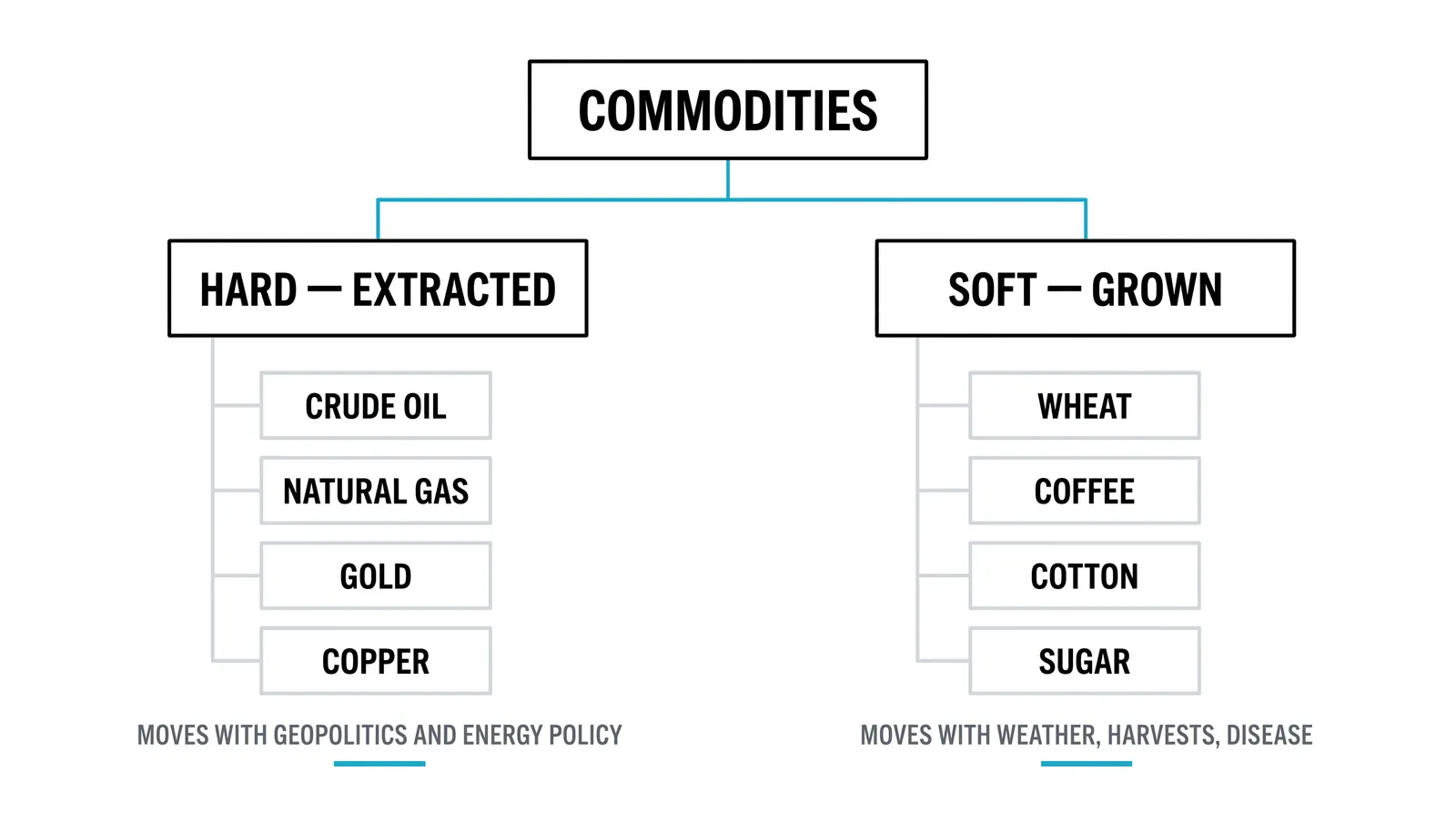
Commodities fall into two broad groups. Hard commodities are extracted: crude oil, natural gas, gold, silver, copper. Soft commodities are grown or raised: wheat, corn, coffee, sugar, cattle.
What makes them tradable is standardization. A futures contract specifies the exact quantity, the quality grade, and the delivery date. One crude oil contract is always one thousand barrels of a defined grade. One corn contract is always five thousand bushels.
Because every contract is identical, anyone can trade with anyone. You are not buying "some oil." You are buying the contract, and the contract is the product.
How Commodity Trading Works
Futures contracts dominate this market. A futures contract is an agreement on a price today for a set quantity delivered at a set date in the future.
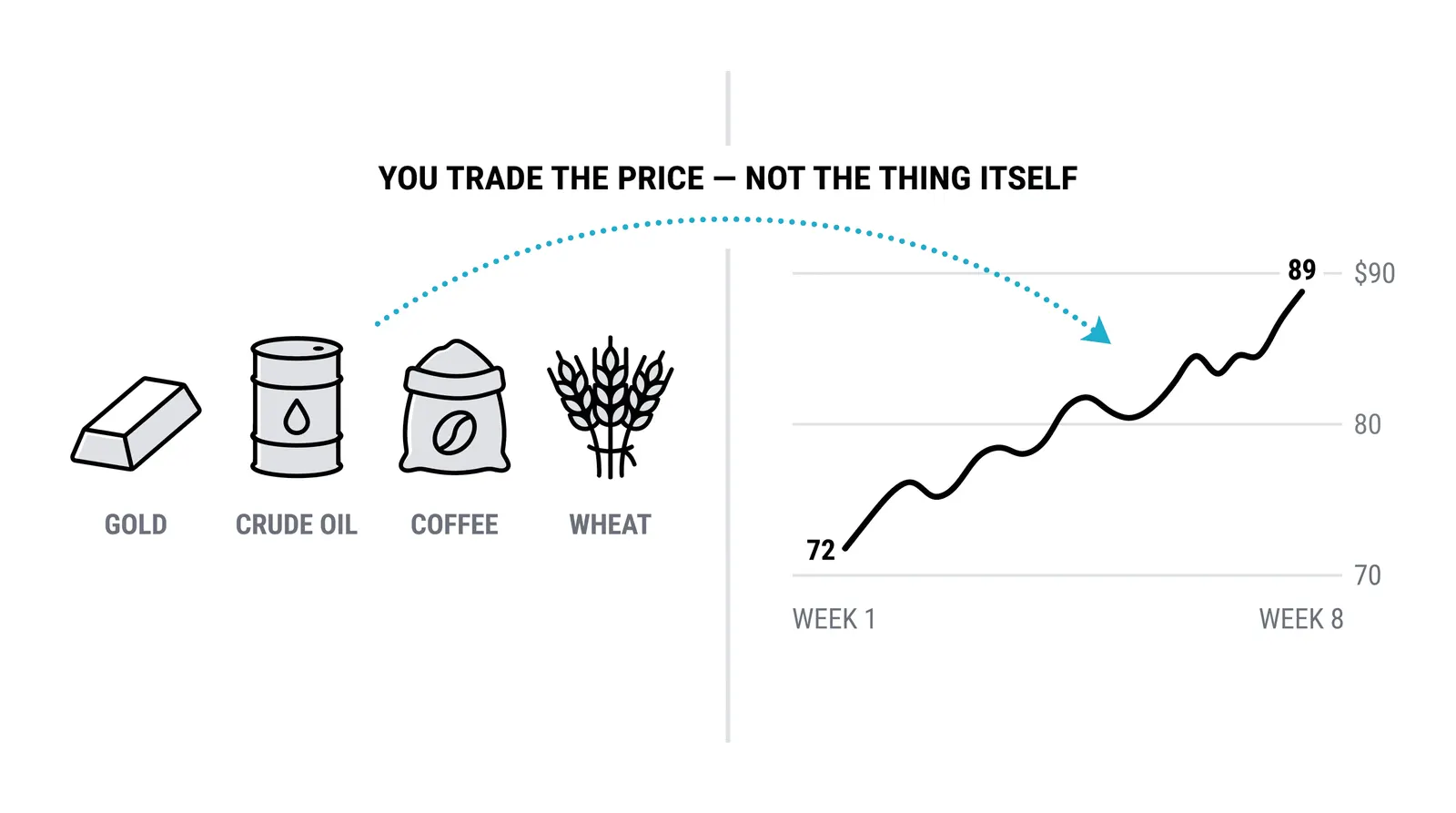
What surprises new traders: almost nobody takes delivery. Most traders close the contract before expiry and settle the difference in cash. You will never see a barrel of oil or a bushel of wheat. You are trading the price, not the goods.
The mechanics of futures, including expiry, rollover, and margin, get their own lesson in the futures lesson. For now, hold one idea: every commodity trade has a clock on it. The contract expires whether you are ready or not.
What Moves Commodity Prices
Supply shocks lead the list. A drought cuts a wheat harvest. A conflict disrupts oil output. A producers' group announces production cuts. Supply falls, price rises, often fast.
Demand comes second. Economic growth pulls demand for energy and industrial metals. Seasons matter too: heating fuel demand rises in winter, gasoline demand rises in summer driving months.
Inventory levels act as the buffer. When warehouses and storage tanks are full, the market can absorb a shock. When they are empty, a small disruption moves price a long way.
Finally, the dollar. Most commodities are priced in US dollars. A stronger dollar makes commodities more expensive for the rest of the world, which pressures prices. A weaker dollar does the opposite. Currency traders already watch this; commodity traders must.
Why Traders Choose Commodities
The drivers are things you can see in the real world. A frost, a hurricane, a harvest report. Many traders find this easier to reason about than central bank language or corporate accounting.
Commodities also produce strong, sustained trends when supply genuinely tightens. A real shortage does not resolve in a day. Prices can trend for weeks or months while the physical market works through it.
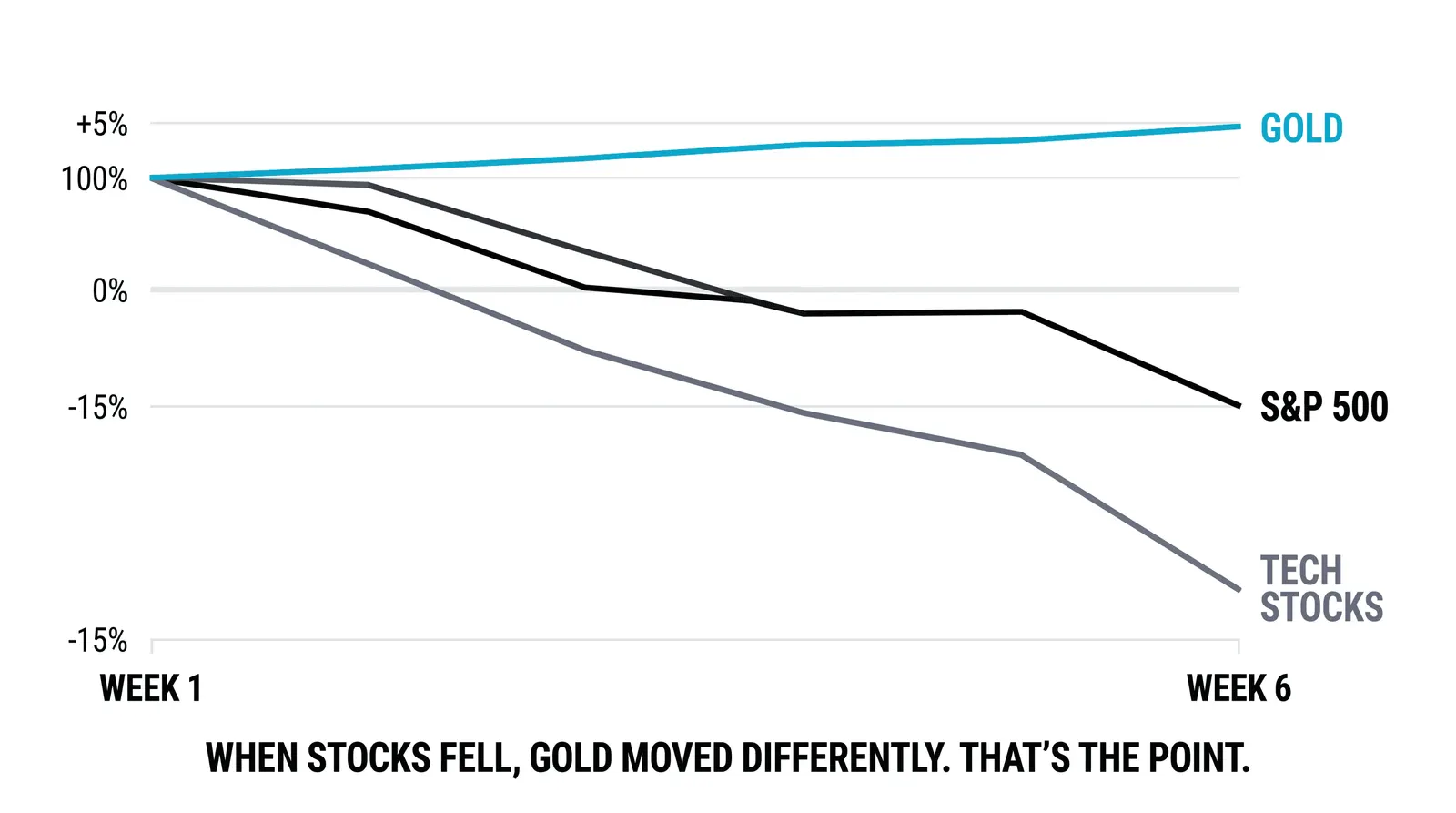
And commodity prices often do not track stocks. For a trader who wants variety in what they watch, that independence has real value.
What Makes Commodities Demanding
Volatility arrives with headlines. A single weather forecast or geopolitical headline can gap the market before you can react. Stops help, but gaps can jump over them.
Contract expiry forces decisions. You cannot sit in a losing position indefinitely and hope. The contract ends, and you must close, roll, or take the loss.
Margin-based sizing is standard. Leverage, in the literal trading sense, means a small deposit controls a large contract. Small price moves become large account moves, in both directions. This is where most new commodity traders get hurt. Not by being wrong about the weather, but by sizing the position as if being wrong were cheap.
A Worked Example
Hypothetical numbers, kept round for clarity. A trader expects a colder-than-normal winter to tighten natural gas supply. They buy one contract covering 10,000 units at 3.00.
The cold forecasts arrive. Storage draws down faster than expected. Price climbs to 3.60.
Sixty cents on 10,000 units is a 6,000 swing on one contract. If the winter turns mild instead, the same math runs against them.
Notice what did not happen: that frost did nothing to a software stock. The driver was physical, and the trader followed it in the physical market. Commodity trading, in miniature, inside one trade.
Commodities vs Stocks vs Forex
| Commodities | Stocks | Forex | |
|---|---|---|---|
| What mainly moves it | Physical supply and demand: weather, harvests, production, inventories | Company earnings, sector news, broad economic sentiment | Interest rates, central banks, relative economic strength |
| The driver you track | Real-world events you can often see coming: seasons, reports, conflicts | Company performance and market mood | Macro data and policy decisions |
| The contract reality | Futures with expiry dates; margin-based sizing is standard | Shares you can hold indefinitely; no expiry | Spot or derivatives; no expiry on spot, heavy margin use |
None of these is easier. They are different games with different scoreboards. Pick the one whose drivers you actually enjoy following, because you will be following them for years.
Who Commodities Fit
Commodities suit traders who already follow real-world supply and demand news. If you read about weather patterns, energy policy, or harvest reports and find it interesting rather than tedious, this market rewards that habit.
They also suit swing traders who like strong trends. When a genuine shortage develops, commodity trends can run further and cleaner than stock trends.
They fit poorly if you want to set a position and forget it, or if sharp overnight moves will shake you out of sound trades. Be honest about your temperament before you commit.
Questions About Commodities
Are commodities good for beginners?
They can be, but only with small size and real respect for volatility. The drivers are intuitive, which helps learning. The margin-based sizing is not forgiving, which punishes it. Many traders start by watching commodity charts alongside their main market before risking money.
Do I have to take delivery of the goods?
No. Retail traders close or roll their contracts before delivery, and brokers require it. The delivery mechanism exists to anchor futures prices to the real physical market, not to fill your garage with oil barrels.
How much capital do I need?
Enough that one contract's normal daily swing is a small fraction of your account. Margin requirements vary by contract and broker, but the margin is the minimum to open the trade, not a sensible account size. If a routine losing day would damage you, the account is too small for that contract.
Why do commodities spike on the news?
Because supply and demand are physical and cannot adjust instantly. When a headline changes the expected harvest or threatens production, traders reprice the entire future shortage at once. Stocks can grow into bad news over quarters. A wheat crop cannot.
Your next step is the futures lesson, where the mechanics behind everything here, expiry, rollover, and margin, get the detailed treatment they need before you trade a single contract.