Reading the Ichimoku Cloud
Ichimoku readings follow an order of operations, and the order matters more than any single line. First, take your bias from where price sits relative to the cloud. Second, read momentum from the Tenkan against the Kijun. Third, look for confirmation from the Chikou. Only after all three do you treat anything as a signal.

Skip that order and the same crossover can mean opposite things on two different charts. Think of it like walking a museum in room order, where each gallery only makes sense after the one before it, and skipping rooms leaves you staring at art with no context. The earlier lesson in this level covered what the parts are and how they are built. This lesson is about the reading order and the decisions that come out of it.
Price Versus the Cloud: Three States
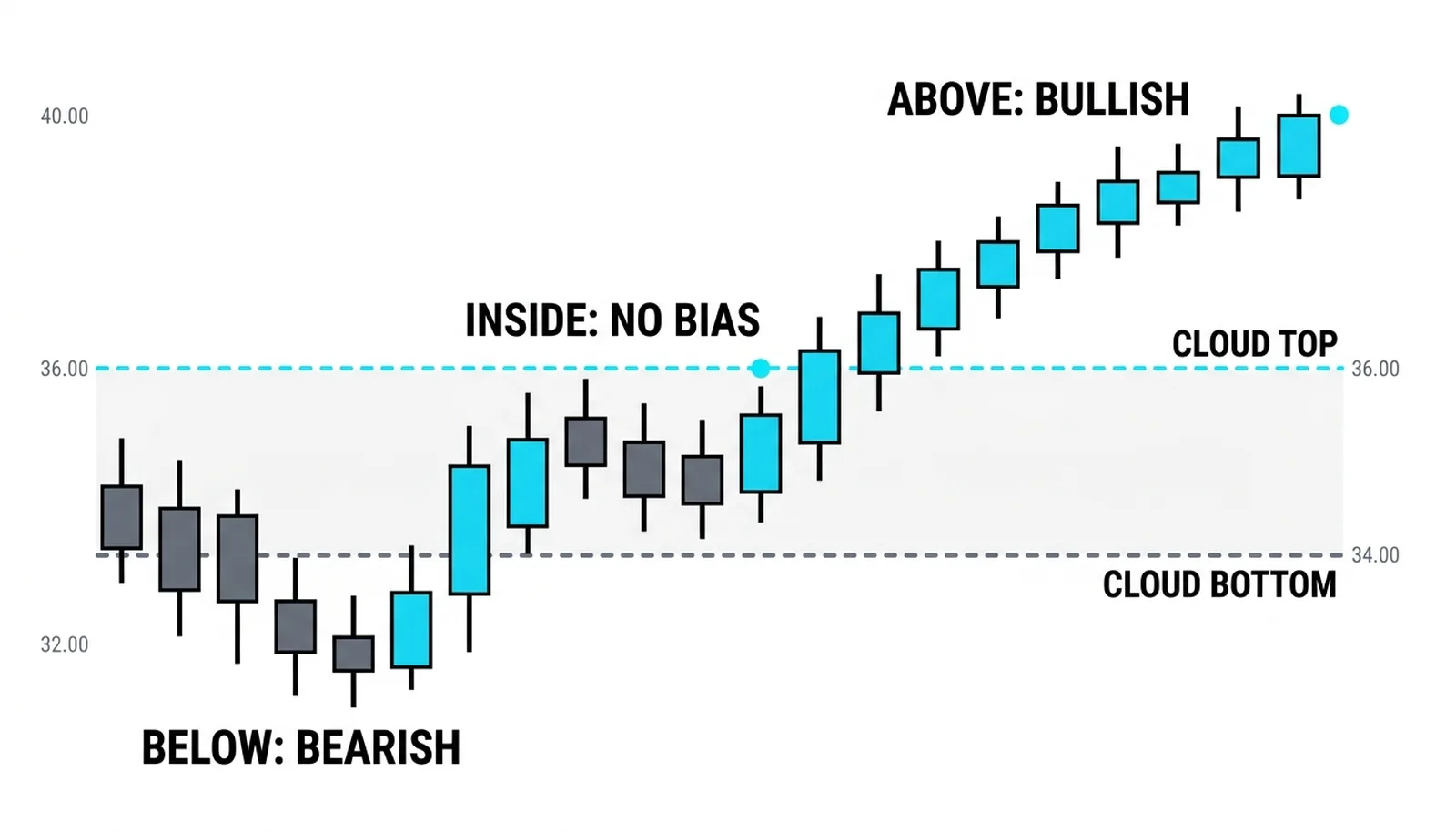
Everything starts with one question: where is price relative to the cloud. There are only three possible answers, and each one sets a different bias.
Above the cloud means bullish bias. Buyers control the chart, and the top of the cloud acts as first support on pullbacks. A dip into that upper edge is a test, not a breakdown, until price closes back inside.
Below the cloud means bearish bias. Sellers have the chart, and the bottom of the cloud acts as first resistance. Rallies into that lower edge are where short ideas get interesting and where longs have no business.
Inside the cloud means no bias. Price is in the zone where the market has not agreed on direction. This is the state most traders hate, and it is also the most common one. Most charts spend most of their time inside or near the cloud. Accepting that saves you from forcing trades in the worst location on the chart.
One blunt rule follows from this: if you cannot state the bias in one sentence, you do not have a trade.
The Twist: What the Future Cloud Says
The cloud is drawn ahead of current price, which makes it one of the few tools that shows you something about tomorrow instead of only yesterday. When Senkou A crosses Senkou B out in front of price, the future cloud changes color. Traders call this the twist.
A twist ahead of price tells you the market's forward agreement is shifting. It is not a trade by itself. It is a warning that the current condition has an expiry date.
Pay attention to thickness too. A thick cloud ahead means strong projected support or resistance, because the two spans are far apart and the market's agreement is wide. A thin cloud ahead means the market's agreement is thin too. Thin clouds get sliced through with ease. When you see a narrow band of cloud in front of price, treat any support or resistance it offers as weak.
The practical use is simple. A bullish position sitting above a thick, rising cloud has room to breathe. The same position above a thinning, twisting cloud deserves a tighter leash.
Signals That Need Context
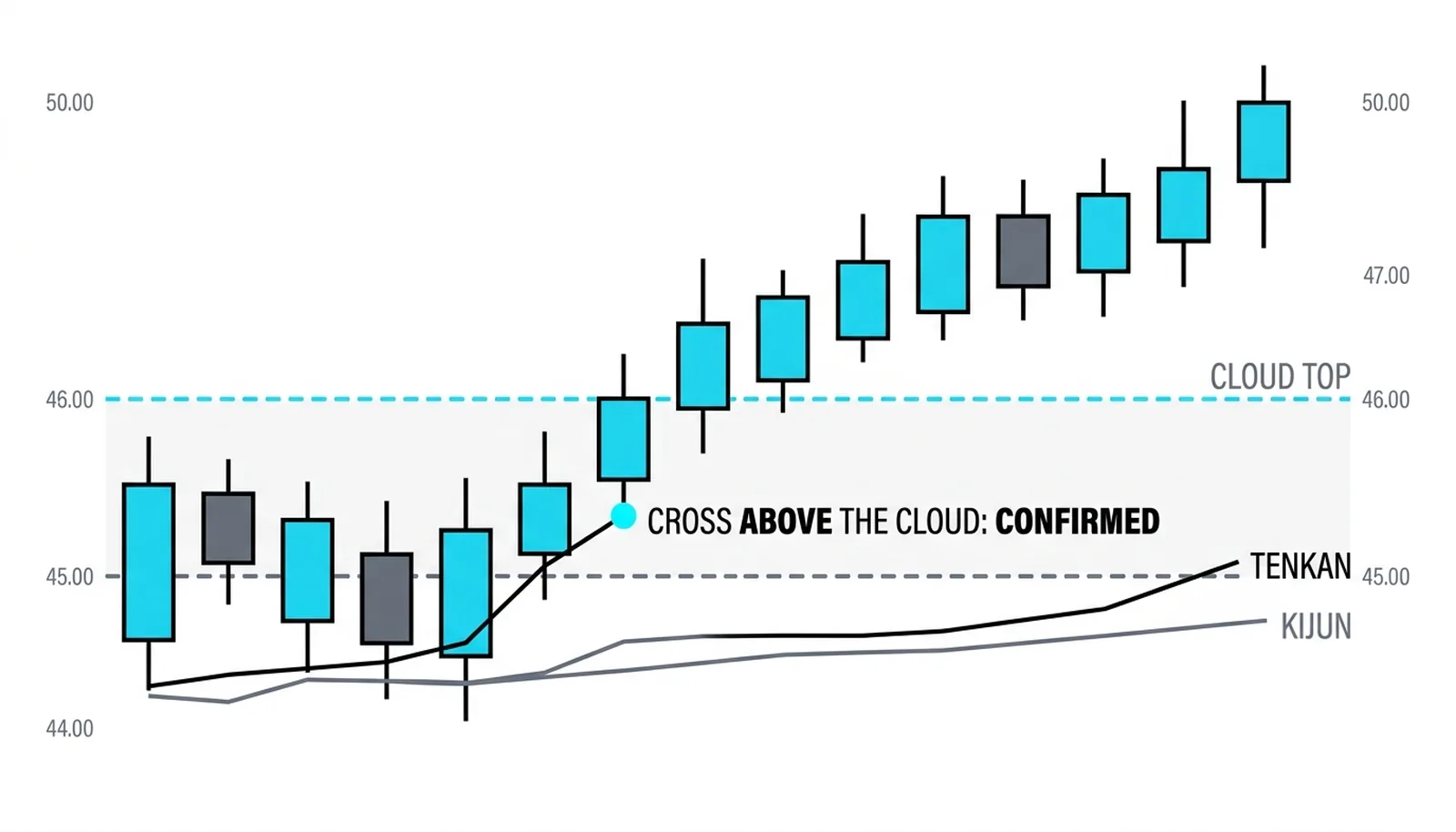
A Tenkan-Kijun cross above the cloud is a different animal from the same cross inside the cloud. Above the cloud, the cross confirms momentum in the direction of an established bias. Inside the cloud, the same cross is noise, because the lines tangle constantly while price chops sideways. Below the cloud, a bullish cross is a countertrend guess at best.
The Chikou is your confirmation layer. When the Chikou sits clear of old price action, with open space around it, the current move has room and the signal carries weight. When the Chikou is tangled in candles from weeks ago, the move is fighting its own history. Treat the Chikou as confirmation, never as a trigger. It validates a read you already made; it does not create one.
The common mistake is treating any single line as a signal. One line crossing another means nothing without the three-step read behind it. Traders who buy every Tenkan-Kijun cross donate money to traders who check location first.
When the cloud is flat and price is stuck inside it, the honest tiebreaker is a strength filter. The ADX lesson in this level covers exactly that: a low ADX tells you there is no trend to trade, which matches what the flat cloud is already saying.
When the Answer Is Wait
Inside the cloud with tangled lines is a real reading, not a failure of the tool. The system is telling you the market has no direction worth paying for. That is information.
Most losing Ichimoku trades come from refusing this answer. The trader sees lines crossing, feels pressure to act, and takes a trade in the one location where the system explicitly says there is no edge. Then the chop grinds them down with small losses and worse frustration.
Waiting is a position. When your read comes back "no bias, lines tangled, Chikou buried in old bars," the correct output is flat. Write it down, set an alert for a cloud break, and go look at other charts. The market will hand you a cleaner read soon enough.
From No-Trade to Bias
Here is a hypothetical walkthrough with round numbers to show the order in action.
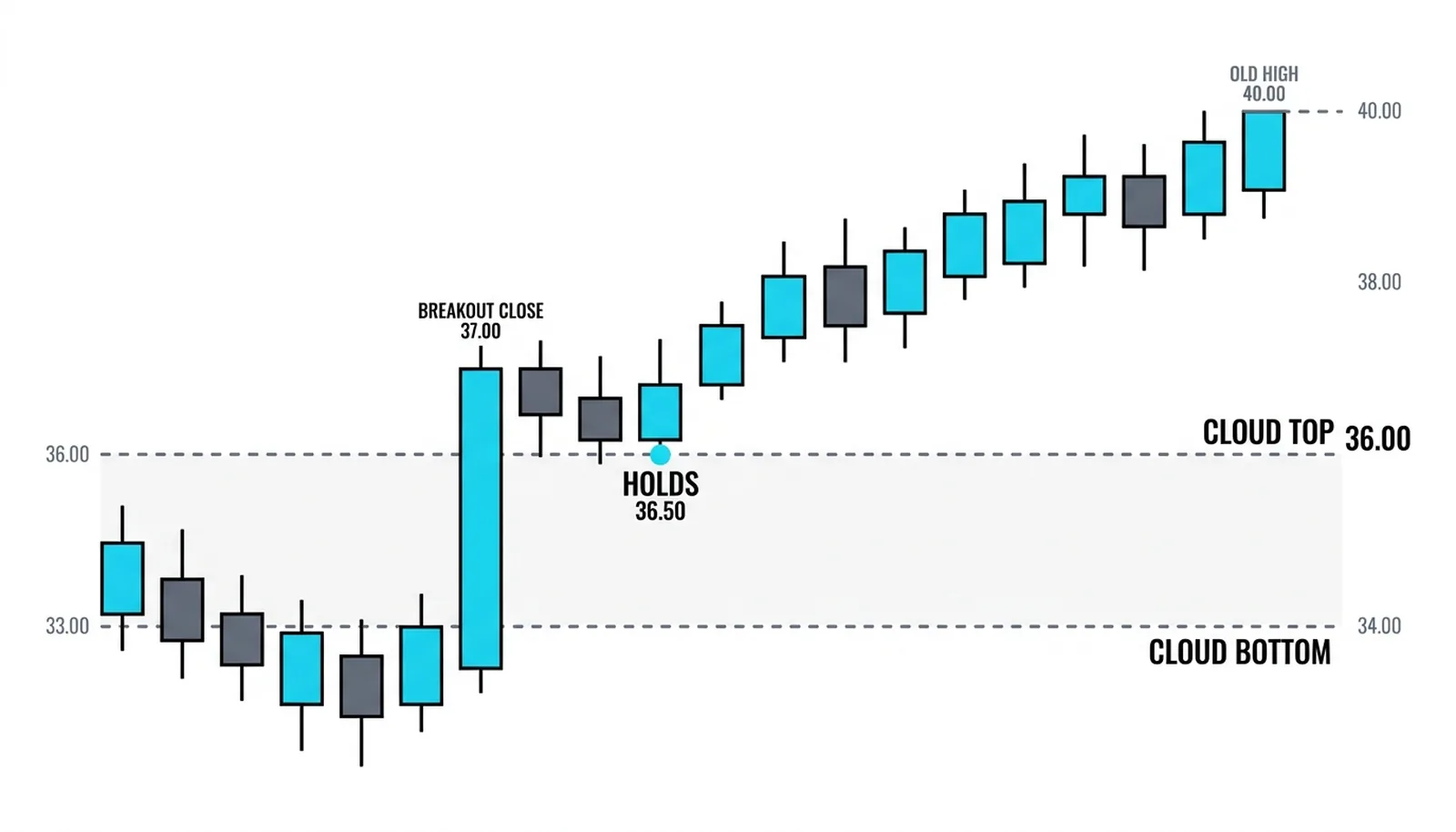
A stock trades at 33. Its cloud sits from 34 to 36 above it. Price is below the cloud, so the bias is bearish and longs are off the table. The cloud bottom at 34 is first resistance. Any rally into 34 is a place where sellers have the structural advantage.
Two weeks later, the stock closes at 37, above the cloud. In the same stretch, the Tenkan crosses above the Kijun, and the Chikou stands clear of the old bars with open space around it. All three steps line up: location flipped, momentum agrees, confirmation is clean. Bias flips bullish.
The stock pulls back to 36.5. The cloud top sits at 36, and the pullback holds above it. First support did its job. The idea rides while price stays above the cloud, with the old high at 40 as the next obvious area where sellers showed up before.
Now the honest counter-case. A few sessions later the stock closes at 35.5, back inside the cloud. Bias is off. No drama, no arguing with the chart, no averaging down. The read that opened the trade has been withdrawn, so the trade is done. If the stock later closes back above the cloud with the lines aligned again, that is a fresh decision made fresh.
| Price location | Bias | What the cloud edges mean |
|---|---|---|
| Above the cloud | Bullish | Cloud top is first support on pullbacks |
| Inside the cloud | None | Edges are unreliable; chop is the default |
| Below the cloud | Bearish | Cloud bottom is first resistance on rallies |
Reading the Cloud, Answered
What does it mean when price is inside the Ichimoku cloud?
It means the market has no directional agreement, and your bias should be flat. Inside the cloud is the system's way of saying the chart is undecided. The correct response is to wait for a close outside the cloud rather than trade the chop within it.
Is a Tenkan-Kijun crossover enough for a trade?
No. The cross only carries meaning after you know where price sits relative to the cloud and whether the Chikou confirms. A cross above the cloud with a clear Chikou is a solid signal. The identical cross inside the cloud is noise.
What does a thin cloud mean?
A thin cloud means the market's agreement is thin, so the support or resistance it offers is weak. Price cuts through narrow clouds easily. Check the thickness of the cloud ahead before trusting any edge to hold.
How do you use the cloud as support and resistance?
When price is above the cloud, treat the cloud top as first support on pullbacks; when price is below it, treat the cloud bottom as first resistance on rallies. A hold at the edge keeps the bias alive, and a close back inside the cloud cancels it.
With the reading order down, the next step is putting the cloud to work in full trade plans, where entries, exits, and risk levels all come off the same chart. That is where the system stops being a picture and starts being a process.