PPI: The Upstream Inflation Signal
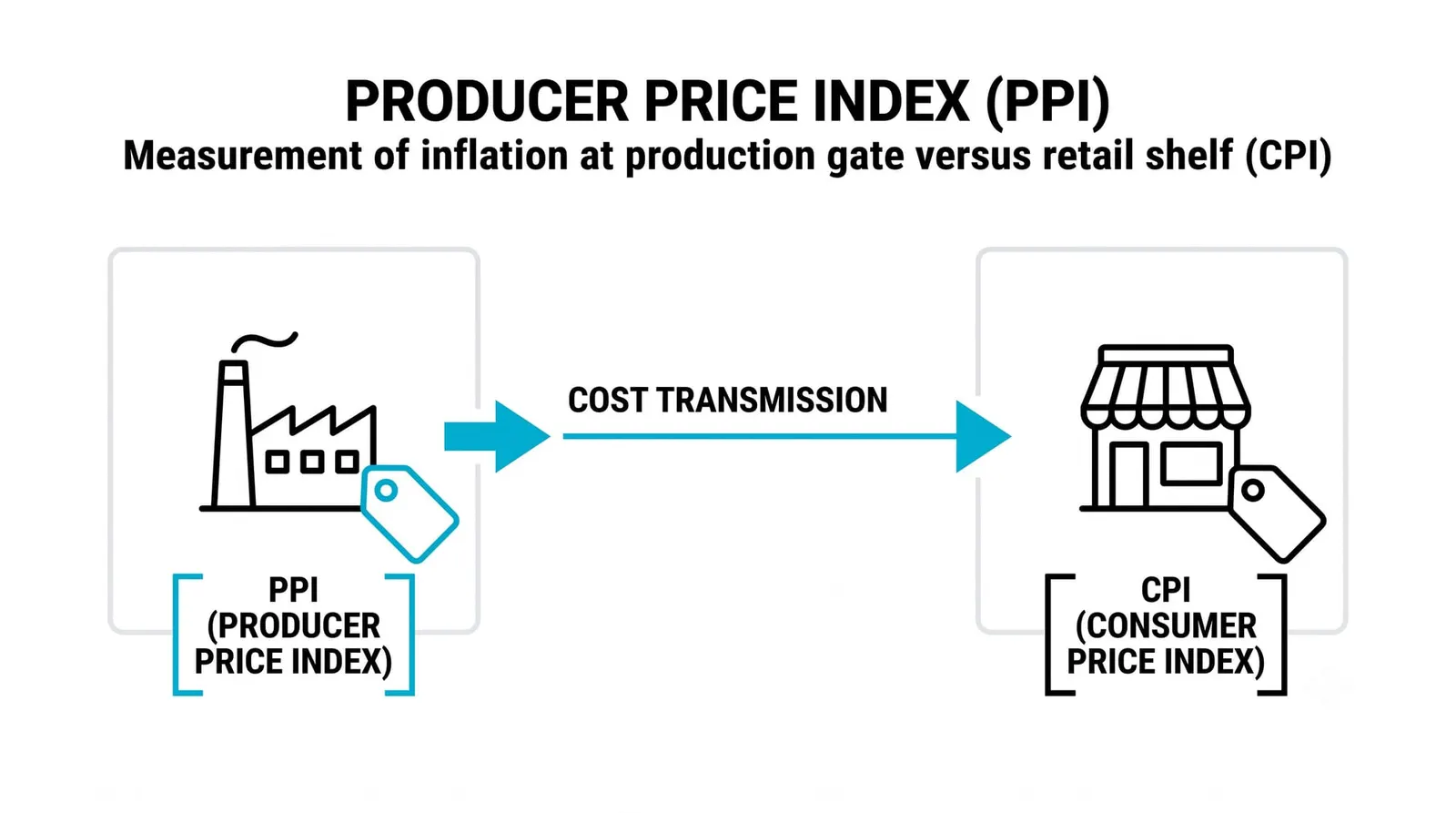
The producer price index, PPI, measures the prices domestic producers receive for what they make, captured at the factory gate before goods and services travel downstream to retailers and households. Traders watch it because it offers an early hint of where consumer inflation, the CPI and PCE you already studied, might be heading.

Think of it this way: the PPI reads the price tags at the factory gate, while the CPI reads them at the store shelf. What happens upstream tends, slowly and imperfectly, to arrive downstream. That single idea explains why a report most retail traders ignore still moves markets.
What PPI Actually Measures
PPI tracks the average change in selling prices received by domestic producers for their output. The key phrase is "received." This is not what consumers pay. It is what the producer books when the product leaves the loading dock.
The index is built at multiple stages of processing. There are readings for crude goods, intermediate goods, and finished goods. A barrel of oil, a tank of refined fuel, and a delivered shipment of plastic packaging each live at a different stage, and each gets measured.
Historically the index was goods-heavy. The program structure later added a services side, so transportation, warehousing, trade margins, and various business services now appear in the headline report. Still, goods carry more weight than they do in consumer gauges, which matters for how you read it.
Like every major release, PPI comes out monthly and is subject to revision. A hot print can cool on revision, and a quiet print can be revised upward. Treat the first number as a draft, not a verdict.
Why PPI Is Called the "Upstream" Signal
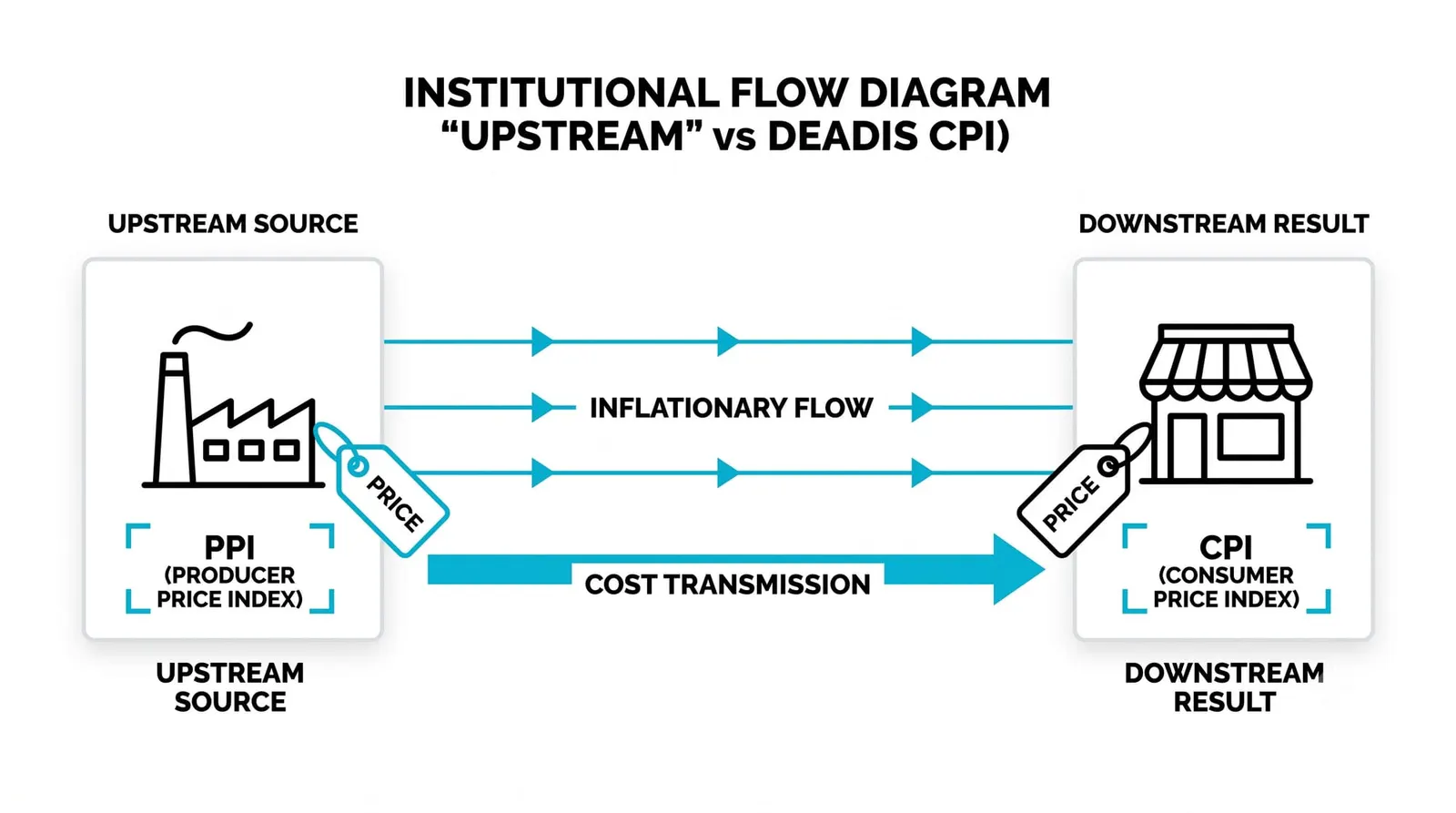
Producers sit at the front of the pricing chain. When energy or commodity costs rise, the producer feels it first, long before a shopper notices anything at checkout.
When input costs climb, the producer faces a fork. Absorb the higher cost and watch margins shrink, or raise output prices and pass the cost along. That decision belongs to the business, and it is never guaranteed to go one way.
A firm with strong demand and little competition passes costs through quickly. A firm in a crowded market with cautious customers often eats the increase instead. Same input shock, different outcomes downstream.
This is why PPI is called upstream. It measures the pressure building at the source of the river, not the water level at the town downstream. Pressure at the source usually matters eventually, but "eventually" can mean months.
How PPI Can Hint at Where CPI Is Headed
You already covered CPI in its own lesson earlier in this level, so the short version here: CPI measures what households pay out the door. PPI measures what producers receive before that. The overlap is partial, and the differences are the point.
Some PPI components feed consumer gauges fairly directly. In the US structure, items like airline fares and trade services margins flow into the consumer-side calculations. Economists actually mine the PPI report for these pieces when forecasting the consumer prints.
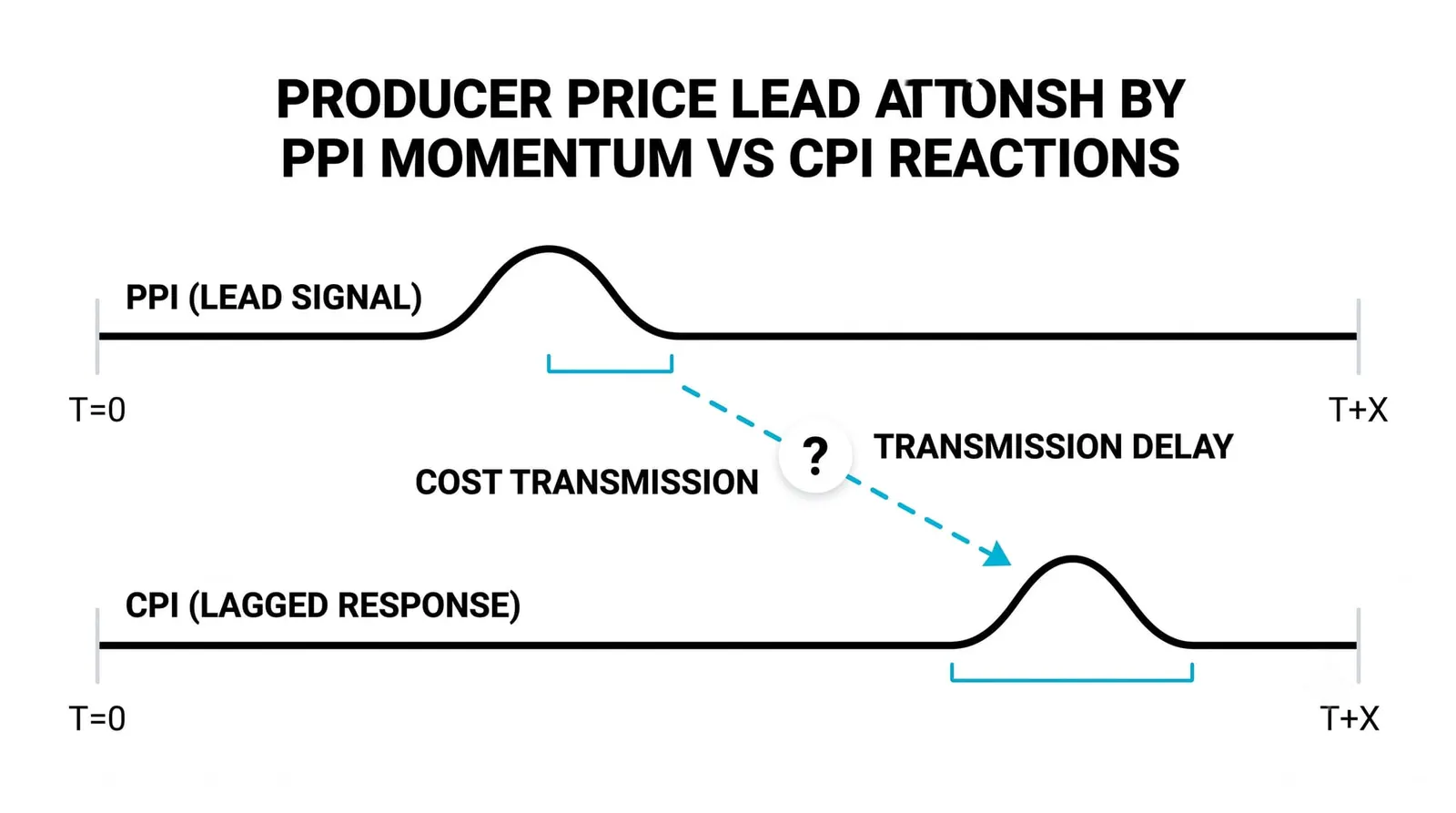
The broader signal is slower. When producer costs run hot for several months in a row, the question stops being whether costs are rising and becomes when, and how much of it, reaches consumers. A single hot month can be noise. A sustained trend at the producer level is harder for businesses to absorb forever.
The correlation between PPI and CPI is real but loose. Goods pass through faster than services. Competitive industries pass through less than concentrated ones. And consumer prices carry big components, like shelter, that barely touch the producer index at all. Respect the signal without worshipping it.
Why Markets Still React Less to PPI Than CPI
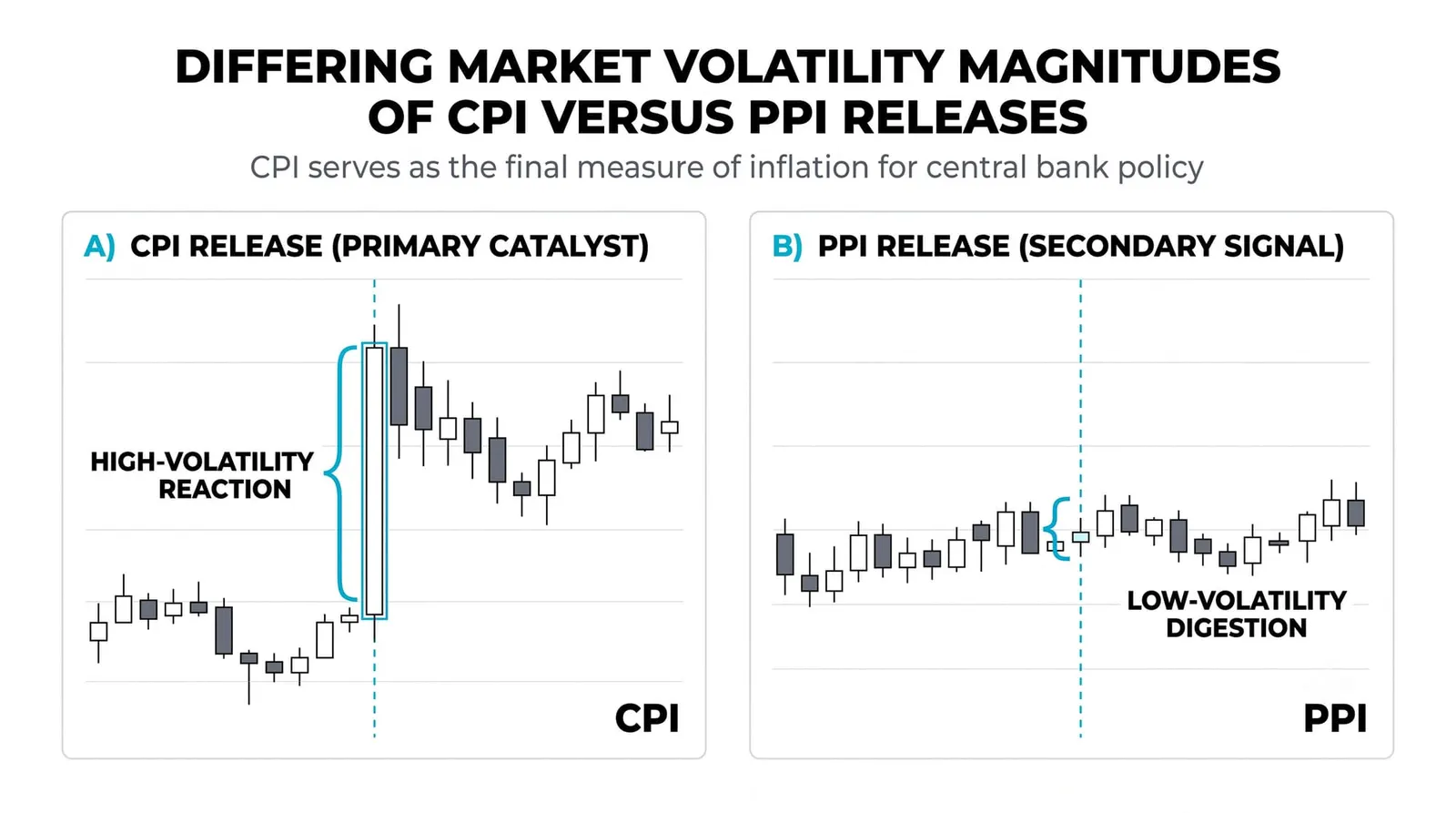
Step back to the Fed's framework from earlier lessons. The Fed targets consumer inflation, and PCE is its preferred gauge, as you learned in that lesson. PPI sits one step removed from that target, which caps how much weight a single print carries.
Services also dominate the consumer economy, and services weigh more heavily in the gauges the Fed reads than in PPI. A producer report can look calm while service-sector inflation runs hot, or the reverse. Markets know this and discount accordingly.
So PPI day usually trades as a preview, not the main event. A surprise moves rates and the dollar, but the move is often smaller and fades faster than a CPI surprise of the same size. Traders treat it as evidence for the next consumer print rather than a standalone verdict on inflation.
That said, "usually" is doing work in that sentence. When PPI has been running hot for months and the market is anxious about inflation, a big producer surprise can hit hard because it confirms a trend people already fear. Context decides the reaction, not the release alone.
One Commodity, Two Indexes
Here is a purely hypothetical illustration with round numbers. Imagine a key industrial input commodity jumps 12 percent in a single quarter. Nothing about current markets, just arithmetic.
The PPI shows it first. Producers who buy that commodity see costs rise immediately, and the intermediate-goods stage of the index starts climbing within a month or two. The headline producer print runs hot.
Now the producers face the fork. Consider three scenarios:
- Full pass-through in two months. Producers raise output prices by the full cost increase quickly. CPI starts climbing within a quarter, and two quarters later the consumer index shows a visible bump in goods categories, say a 2 to 3 percent lift in the affected categories.
- Half pass-through over six months. Producers absorb half the cost, pass along the rest gradually. CPI rises more slowly, maybe 1 to 1.5 percent in the affected categories by the two-quarter mark, and producer margins stay squeezed the whole time.
- No pass-through. Demand is weak, customers balk at any increase, and producers eat the entire cost. Two quarters later CPI barely moves in those categories, but corporate margins have compressed, which shows up later in earnings instead of inflation.
Same commodity shock, three different consumer outcomes. The PPI print told you the pressure existed. It could not tell you which scenario would play out. That judgment requires demand conditions, competition, and time.
| Index | Whose prices it reads | When they show up | Best at |
|---|---|---|---|
| PPI | Prices domestic producers receive for output | Monthly, revised; earliest in the chain | Early warning on pipeline cost pressure |
| CPI | Prices urban consumers pay out of pocket | Monthly, revised; downstream of producers | Headline household inflation read |
| PCE | Prices of everything consumers actually buy, with shifting weights | Monthly, revised; downstream, broader scope | The Fed's preferred inflation gauge |
| All three | Different points on the same pricing chain | Released on separate dates each month | Triangulating where inflation pressure sits |
The PPI Report, Answered
Does PPI include services?
Yes, the modern program includes a services side covering things like transportation, warehousing, and trade margins. Goods still carry more weight than they do in consumer indexes, so the report leans goods-heavy in practice.
Why do PPI and CPI sometimes disagree in the same month?
They measure different baskets at different points in the chain. CPI includes shelter and a large services block that PPI barely touches, while PPI captures commodity swings that producers may never pass along. Divergence in a single month is normal, not a data error.
Can PPI fall while CPI rises?
Yes, and it happens. Falling producer costs can coexist with rising consumer prices when services and shelter drive the consumer index, or when earlier cost increases are still working their way through. The two indexes run on different clocks.
How should a new trader use the PPI print?
Apply the beat, miss, and in-line framework from the data-release lesson, then treat the result as evidence about the next consumer print, not a standalone trading signal. Watch the trend across several months, note which components are driving it, and size your reaction smaller than you would for CPI. The producer report tells you where pressure is building; the consumer reports tell you whether it arrived.
Next in this level, you will move from measuring inflation to watching how growth itself gets counted, starting with GDP and why its revisions can matter as much as the headline.