Market Sentiment: Fear and Greed
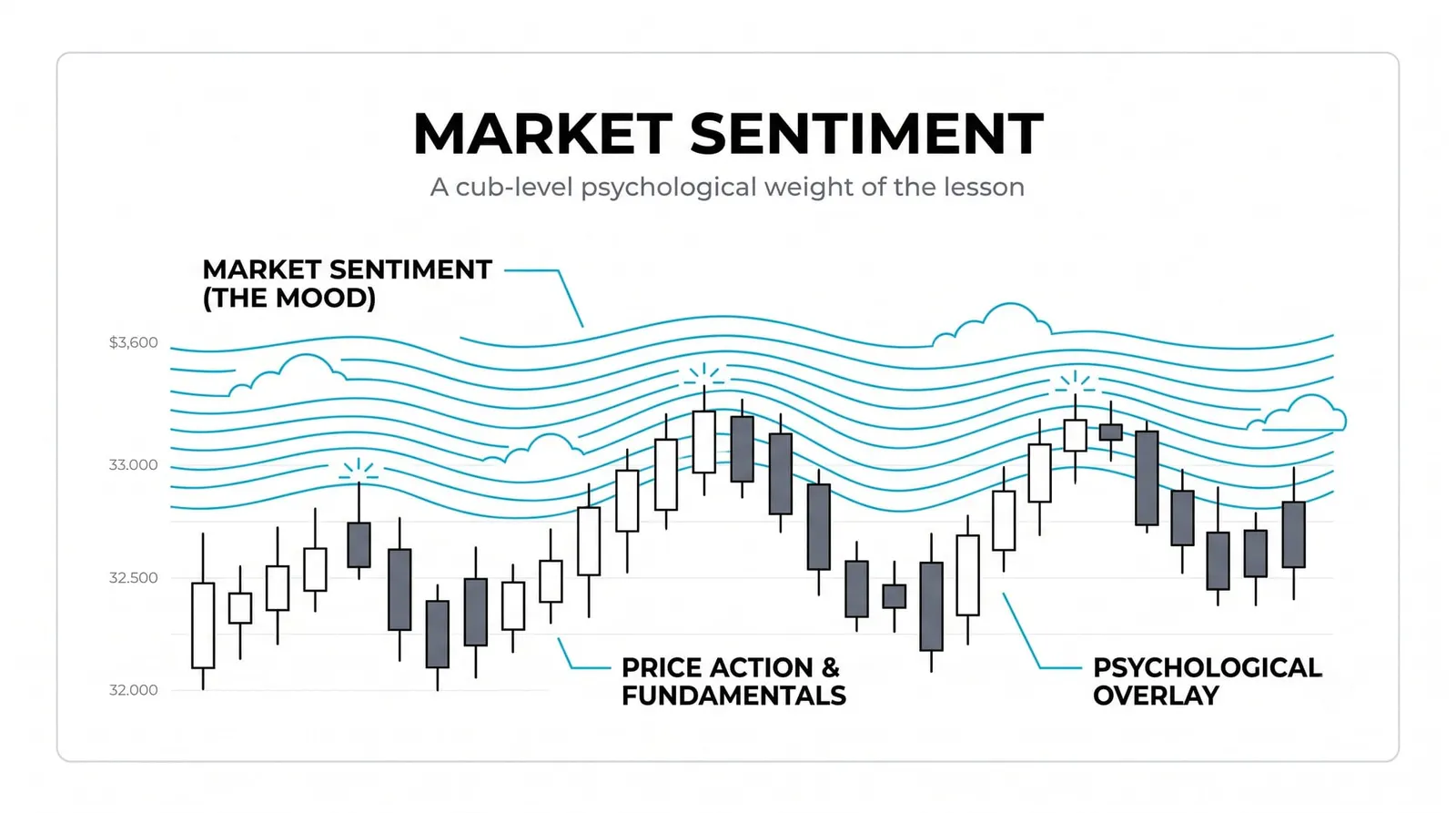
Market sentiment is the prevailing mood of the crowd that trades an asset, the balance between fear and greed at any given moment, and it drives short-term price behavior at least as much as the underlying facts do. Two traders can look at identical data and reach opposite conclusions because one is frightened and one is greedy. That mood difference shows up in the price tape.

Think of sentiment as a pendulum that swings between fear and greed, and the extremes are where crowd behavior becomes most predictable. In the middle, moods are mixed and prices chop around. At the far ends, nearly everyone has already chosen a side, and that one-sidedness is itself information.
You met a version of this earlier in this level when we covered risk sentiment in the currencies section. This lesson goes deeper and broader, into what sentiment is, how it gets measured, and how to use it without mistaking it for a signal.
What Market Sentiment Actually Is
Market sentiment is the aggregate of what traders and investors feel and expect about an asset or the market as a whole. It is not a single number you can look up. It lives in positioning, in money flows, and in the way prices behave when new information arrives.
When traders expect good things, they buy aggressively, chase breakouts, and treat bad news as noise. When they expect trouble, they sell rallies, hoard cash, and treat good news with suspicion. The data is the same in both cases. The mood filters it.
Keep sentiment separate from fundamentals in your head. Fundamentals are the earnings, the growth rates, the interest rates, the cash flows. Sentiment is how the crowd feels about those facts right now. A company can report strong numbers and fall anyway if the crowd expected perfection. The facts did not change. The mood did the damage.
This is why two markets with similar fundamentals can behave so differently over a few weeks. One is loved and one is ignored, and that emotional gap shows up in every tick.
Why Sentiment Drives Price in the Short Run
Prices move because someone buys and someone sells, and the willingness to do either is mood-driven. Over long stretches, fundamentals pull prices toward value. Over days and weeks, emotion does most of the pushing.
The mechanism is simple supply and demand with a psychological twist. Greed increases the urgency to buy, which lifts prices, which creates more greed. Fear increases the urgency to sell, which drops prices, which creates more fear. Each loop feeds itself until it runs out of fuel.
Fuel is the key idea. When everyone who wants to buy has already bought, there are no buyers left, and even a small piece of bad news can start a slide. When everyone who wants to sell has already sold, there are no sellers left, and a small piece of good news can spark a rally. Crowded trades are fragile trades.
That is the structural reason extremes matter more than the middle. A balanced market has buyers and sellers available on both sides. An extreme market has used up one side entirely.
How Sentiment Gets Measured
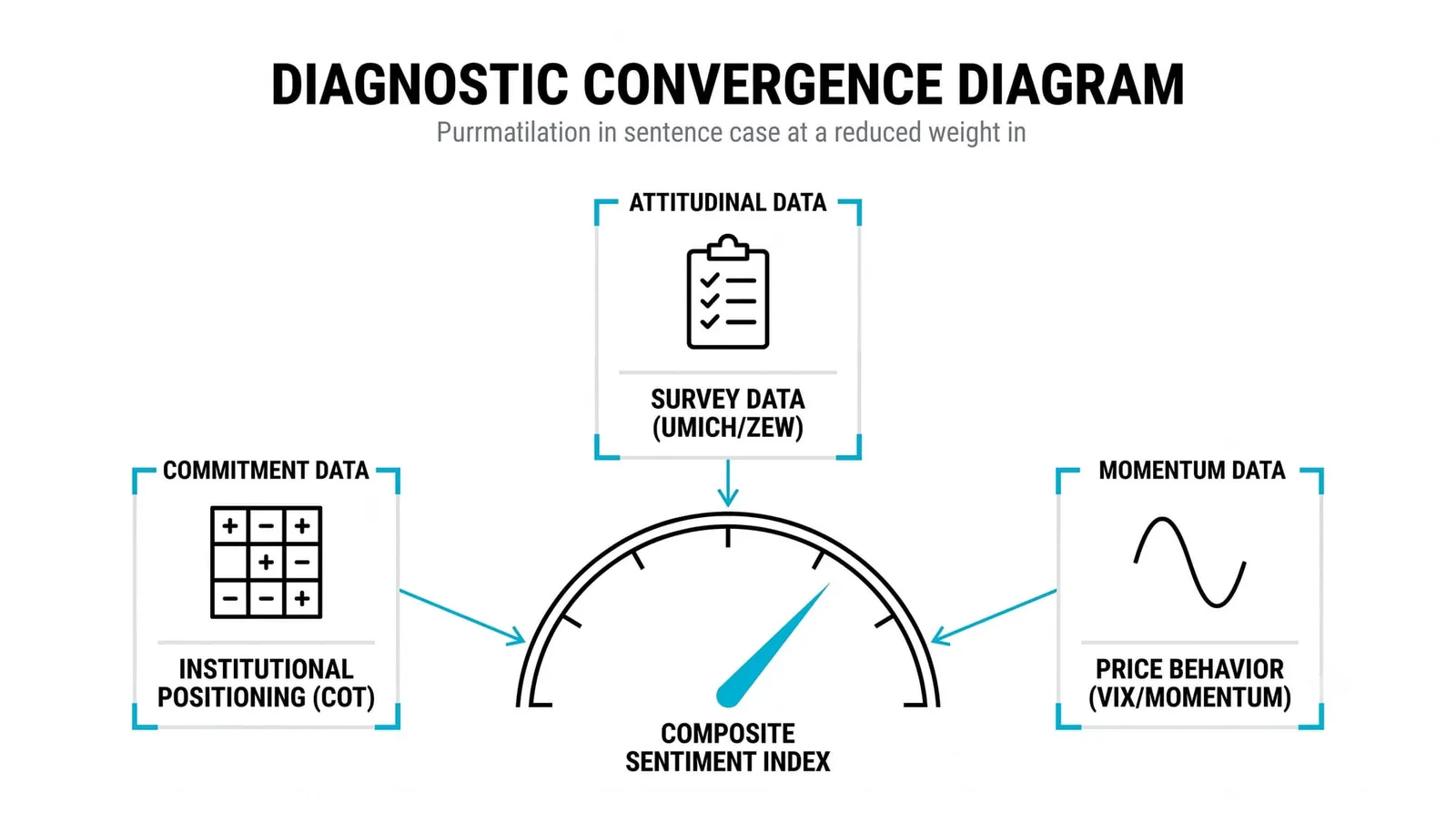
No single gauge captures mood, so traders triangulate from several sources. Each one sees a different slice of the crowd.
Investor surveys ask traders and advisors directly whether they are bullish or bearish, then publish the split. Volatility indexes measure how much traders are paying for protection, which rises when fear rises. Positioning reports show what large speculators and commercial players actually hold, revealing where the crowd has placed its bets. Safe-haven flows track money moving into or out of assets people buy when they are scared, like certain currencies, government bonds, or gold.
Each tool has a blind spot, which the table below lays out. Two of these tools get their own lessons next: the Commitments of Traders report, which breaks down futures positioning, and the VIX, the best-known volatility index. For now, know that they exist and what family they belong to.
| Tool | What It Measures | Its Blind Spot |
|---|---|---|
| Investor surveys | What traders say they feel, bullish versus bearish | People say one thing and do another; stated mood lags actual positioning |
| Volatility indexes | The price of protection, implied fear in options markets | Can stay calm during slow tops and spike after the worst selling is done |
| Positioning reports | What large traders actually hold, long versus short | Published with a delay; shows where the crowd was, not where it is |
| Price behavior itself | How the market reacts to news, dips, and rallies | Requires judgment; easy to read your own bias into the tape |
Fear and Greed: What the Extremes Look Like
Greed has a recognizable signature. Buyers pay up without hesitation. Dips get bought within hours, sometimes minutes. Valuations stretch well beyond historical norms and nobody cares, because the story feels airtight. Traders who sat out feel pain and finally jump in, which is often the last wave of buying.
Fear has its own signature. Selling becomes indiscriminate. Correlations between assets move toward one, meaning everything falls together regardless of quality. Good assets get dumped alongside bad ones because scared sellers raise cash wherever they can. Rallies fail quickly because every bounce meets someone desperate to get out.
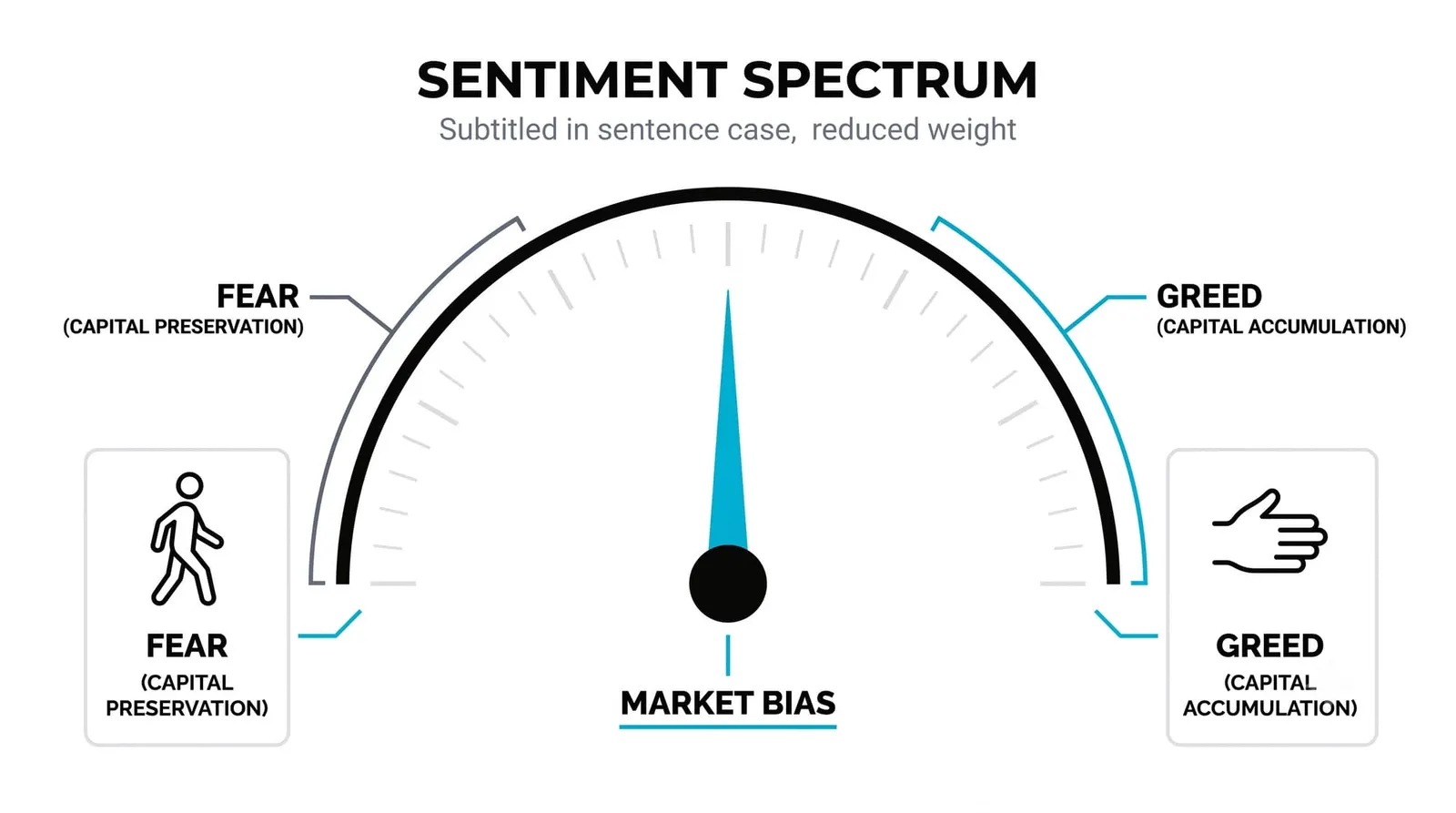
Each extreme carries information. Euphoria tells you the crowd has spent its buying power and expectations are set impossibly high. Panic tells you the crowd has spent its selling power and expectations are set impossibly low. Neither extreme tells you when the turn comes. They tell you the risk-reward has shifted.
Blunt truth: most traders lose money at extremes because they join the crowd exactly when the crowd has finished acting.
Why Sentiment Is Not a Trigger on Its Own
Sentiment is the backdrop. The trigger is something else: an event, a data release, a price level breaking. Confusing the two is one of the most expensive mistakes new traders make.
A market can stay euphoric far longer than seems reasonable. Shorting purely because everyone is bullish means standing in front of a moving crowd with no idea when it stops. The same logic applies to panic. Buying purely because everyone is terrified can mean catching a market that keeps falling for weeks.
What a crowded trade gives you is a map of the risk. If positioning is heavily long and sentiment is euphoric, you know the downside reaction to bad news will be violent and the upside reaction to good news will be muted. That asymmetry shapes your trade selection, your sizing, and your patience. The entry itself still needs its own case: a level, a catalyst, a structure you can define risk against.
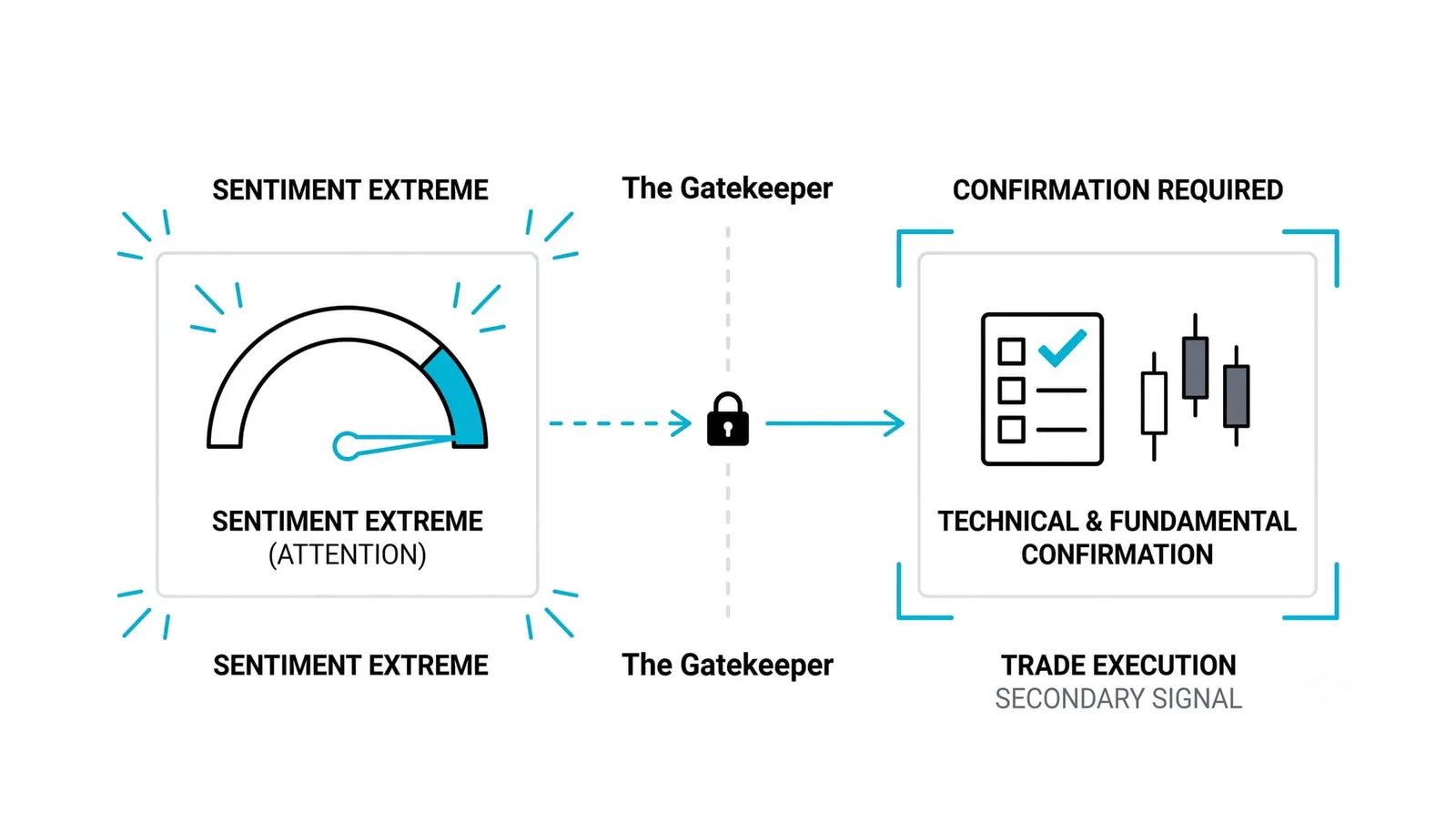
Read sentiment the way a sailor reads the wind. It tells you what conditions you are sailing in. You still need a destination and a helm.
One Index, Two Moods
Here is a hypothetical illustration with invented round numbers. Imagine a stock index that climbs for eight straight weeks. By week eight, a sentiment survey shows 90 percent of respondents are bullish. Positioning data shows speculators heavily long. Financial media treats every gain as proof of more gains to come.
Now a bad headline hits. Over three days, the index drops 5 percent.
Ask why the same headline would have bounced off in week two but broke the market in week nine. In week two, positioning was balanced. Plenty of traders were still on the sidelines with cash, and they saw the dip as a chance to get in. Their buying absorbed the selling. The headline met a wall of willing buyers.
By week nine, that sideline cash was already invested. The 90 percent bullish reading meant nearly everyone who wanted to buy had bought. When the headline hit, there was nobody left to absorb the selling. Worse, the crowded longs all wanted out through the same exit at once, and their selling fed on itself. The headline was the match. The crowded positioning was the pile of dry wood it landed on.
The lesson is that news does not move markets in a vacuum. News lands on a positioning structure, and that structure decides whether the market shrugs or breaks.
Market Sentiment, Answered
Can you trade on sentiment alone?
No, and traders who try usually learn this the expensive way. Sentiment tells you the condition of the crowd, which shapes risk and reward, but it gives you no entry, no exit, and no stop. Pair it with a level, an event, or a structure before putting money to work.
How fast can market sentiment change?
Faster than most new traders expect. A single surprise data release or headline can flip the mood within hours, especially when positioning is crowded in one direction. Deep, slow-building sentiment shifts take weeks, but the swing from calm to panic can happen in one session.
Is contrarian trading the same as reading sentiment?
They overlap but they are not the same thing. Reading sentiment means measuring the crowd's mood and positioning as one input among many. Contrarian trading is a strategy of systematically betting against the crowd at extremes. You can read sentiment without being a contrarian, and most professionals do exactly that.
What is the fear and greed index?
It is a composite gauge that combines several indicators, such as volatility, momentum, and demand for safe assets, into a single score meant to show whether the market is running on fear or greed. Treat it as a quick temperature check rather than a signal, because any single composite hides the details that matter.
Next, you will get hands-on with the measurement tools themselves, starting with the Commitments of Traders report and then the VIX, so you can stop guessing at the crowd's mood and start reading it from actual data.