Inside Bar: Compression Before the Break
Compression is the story of the inside bar. An inside bar is a bar whose entire range fits inside the previous bar's range, a one-bar truce in which neither side pushes a new price. The compression it represents matters because ranges store energy, and the longer the squeeze, the harder the release when one side finally breaks the frame.

Picture a truce line. Both sides stop advancing for a moment, and everyone involved knows the pause ends when one of them moves first. The inside bar is that pause drawn on a chart. Buyers did not push above the last high, sellers did not push below the last low, and the market sat still inside territory already explored.
The bar-by-bar lesson treated every bar as evidence. The inside bar is the quietest evidence on the chart, a bar that says less about direction and more about what is building. When you see one, the question is never where price went. The question is why it stopped going anywhere.
The Structure, Exactly
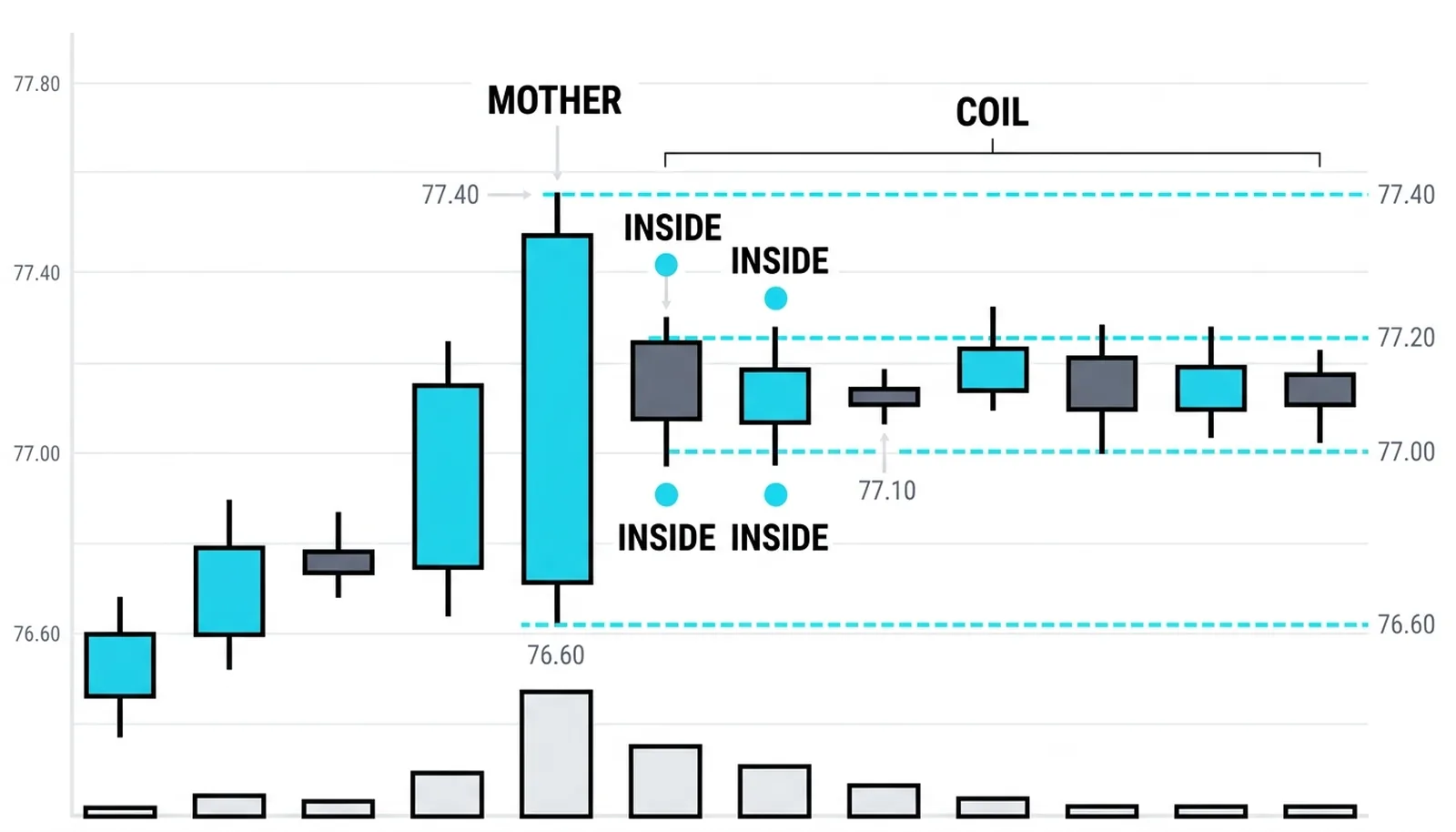
The definition is exact and unforgiving. The inside bar's high sits below the prior bar's high, and its low sits above the prior bar's low. Both conditions must hold. A bar that matches either boundary, or pokes one tick past it, does not qualify.
The prior bar is called the mother bar. It frames the whole setup, because its high and low become the boundaries the market refused to cross. Everything about the trade hangs off those two prices.
Two or three inside bars in a row deepen the squeeze. Each successive bar that stays inside the mother bar's range adds another layer of hesitation, and the compression tightens. The tape-reading framework gives these sequences their own shorthand, treating two-bar and three-bar coils as distinct animals with their own behavior, and the practical takeaway holds: more bars inside the frame means more energy stored behind it.
One detail matters here. When counting multiple inside bars, the frame stays the mother bar's range, not the most recent bar's range. Each new bar must fit inside the original mother bar for the coil to keep building.
Why Ranges Store Energy
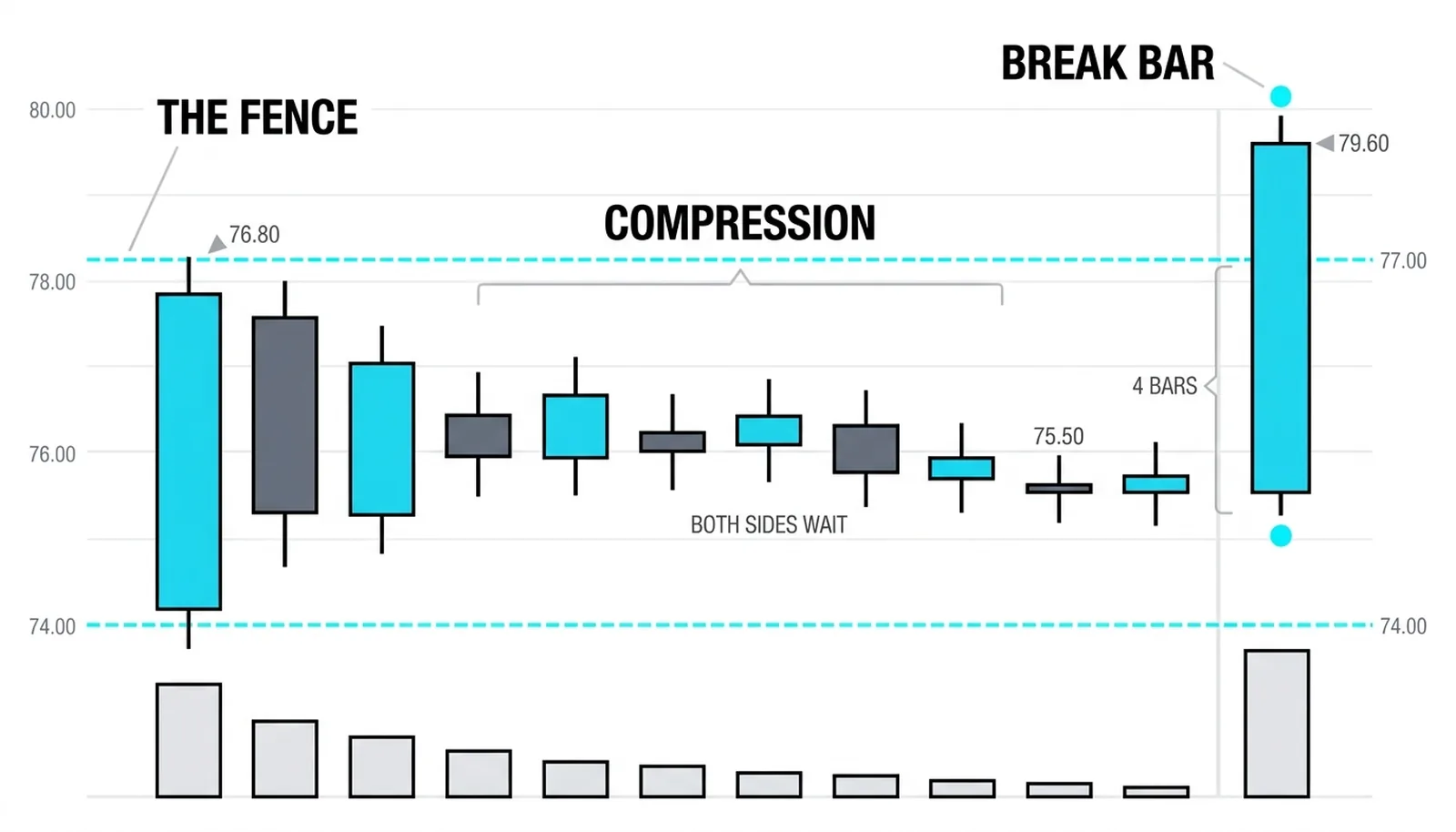
Compression happens because both sides refuse to chase. Buyers will not pay above the recent high, sellers will not dump below the recent low, and the market narrows to whatever both sides will accept. Neither camp is beaten. Both are waiting.
While the truce holds, resting orders pull closer together. Stops cluster just beyond the mother bar's boundaries, breakout entries stack on the same levels, and the order book thickens at the edges of a shrinking range. The auction narrows to a smaller and smaller field while the pressure against the fence grows.
That is the stored energy. When the frame finally breaks, the breakout triggers stops and entries sitting at the boundary at the same moment, and the move feeds itself for the first leg. The release is fast precisely because the pause was quiet.
Where the break happens changes what it means. An inside-bar break in an established trend usually resolves as continuation, the pause that refreshes before the trend resumes. An inside-bar coil sitting at a major level after a long run is the dangerous version, because a break there can be either continuation or the trap the fakey lesson will cover. Same shape, different address, different odds.
Trading the Break, Not the Prediction
The standard trade respects the truce. The trader places orders on both sides of the frame: a buy-stop above the mother bar's high and a sell-stop below its low. The market picks the direction, and the trader picks the management.
When one order fills, the other is cancelled. This one-shot structure is the discipline. It stops the trader from getting long, watching the break fail, and then getting short into the reversal with a bruised ego making the decisions.
Two cautions decide whether this trade works at all.
- The truce breaks in both directions. The shape itself carries zero directional promise, and the trader who decides the direction before the break is predicting, not reading.
- Context kills more inside-bar trades than structure does. An inside bar printed on thin lunchtime volume or in a dead holiday session is not compression, it is absence, and absence resolves into nothing worth trading.
The first caution is about humility. The bar tells you a decision is coming, not which decision. The second is about honesty. A quiet bar in a quiet market stores nothing, because nobody was fighting in the first place.
The Coil at 77.00
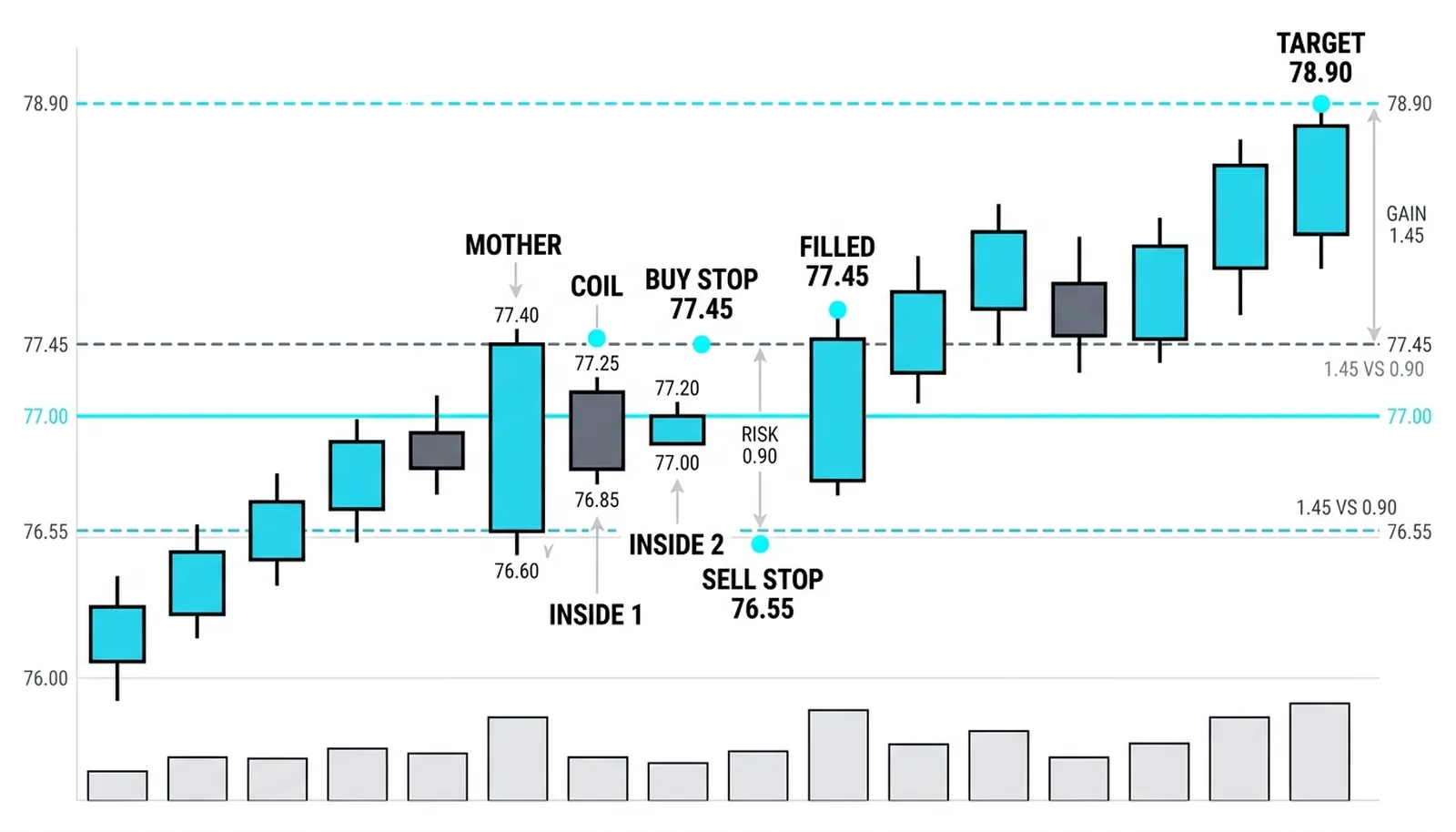
Here is a hypothetical walkthrough with invented round numbers. An uptrend pauses just under a prior swing high at 77.00.
The mother bar runs from 76.60 to 77.40, a healthy bar that stalls right at resistance. The next bar squeezes to 76.85 to 77.25, fully inside the frame. A second inside bar tightens further, 77.00 to 77.20. Three bars, two of them nested, and the range has collapsed to twenty cents while sitting directly beneath the level that matters.
The bracket goes on. The buy-stop sits at 77.45, just above the mother bar's high. The sell-stop sits at 76.55, just below the mother bar's low. Risk on the long side, measured from entry to the sell-stop, is 0.90.
The break fires upward. The buy-stop fills at 77.45, the sell-stop is cancelled, and the release runs to the larger swing high at 78.90. That is about 1.45 gained against 0.90 risked, a healthy multiple earned by letting the market choose the side.
Now the failed version. The break fires downward through 76.55 instead. The sell-stop fills, the buy-stop is cancelled untouched, and the long side was never taken. The trader who pre-committed to the long because "the trend is up" is holding a loser at the exact moment the bracket trader is flat or short. Same chart, same coil, different discipline.
| Element | The Condition | The Read | The Trap |
|---|---|---|---|
| Inside bar | High below and low above the prior bar's range | A one-bar truce, energy storing | Counting a bar that touches or pokes a boundary |
| Mother bar | The bar that frames the setup | Its high and low are the trade's boundaries | Re-anchoring the frame to each new bar |
| Multi-bar coil | Two or three bars inside the mother bar | Deeper squeeze, harder release | Assuming more bars means a certain direction |
| Location | Trend pause versus a major level after a long run | Trend pauses favor continuation | Coils at major levels can break into a trap |
Inside Bar Questions, Answered
What counts as an inside bar?
A bar whose high is below the previous bar's high and whose low is above the previous bar's low. Both conditions must hold exactly. A bar that equals or exceeds either boundary is not an inside bar, no matter how small it looks on the screen.
What is a mother bar?
The mother bar is the bar immediately before the inside bar, the one whose range contains it. Its high and low define the frame for the entire setup, and the bracket orders hang off those two prices. In multi-bar coils, the original mother bar stays the frame for every bar that follows.
Does an inside bar predict direction?
No. The inside bar predicts movement, not direction. It tells you a decision is coming because the range has compressed, and the break of the mother bar's frame reveals which side won. Choosing a direction before the break is guessing with extra steps.
Are multiple inside bars better?
Generally yes, because each additional bar inside the frame deepens the compression and builds more stored energy for the release. The qualification is context. A long coil in a dead, thin market is still absence rather than pressure, and a long coil at a major level is still a toss-up about whether the break is genuine or a trap.
The next lesson moves to the inside bar's aggressive cousin, the outside and engulfing bars, where one side does not pause at all but swallows the prior bar whole.