The Fakey Pattern: a False Break Setup
The fakey pattern is a trap wearing a breakout's clothes. An inside bar forms first, then a bar pushes beyond the mother bar's edge as if a breakout is starting, and then closes back inside the mother bar's range. Everyone who chased the poke is now stranded. The false break is the signal, not the poke itself.

Think of it as a decoy: the visible move is designed to be followed, and following it is exactly what feeds the real move in the opposite direction. The market shows the crowd a breakout, collects their orders, and reverses through them. Your job is to wait for the close that proves the break failed, then trade against the trapped.
The inside-bar lesson built the coil and warned that a break at a level after a long run can be the trap. This lesson is that trap, given its name and its rules.
The Sequence, Bar by Bar
The fakey has a fixed order, and each step has a job.
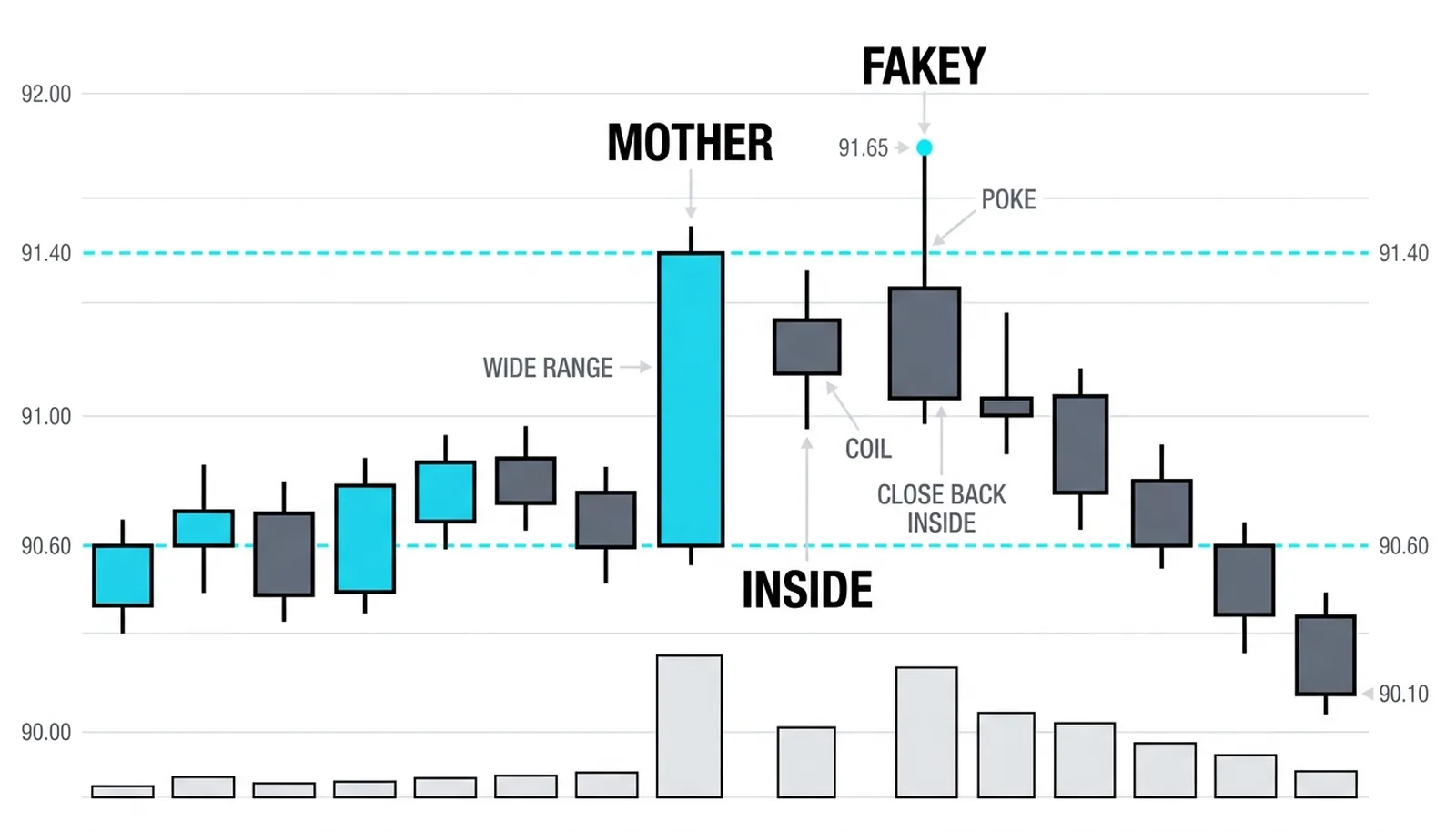
- The mother bar. A wide-range bar prints first. Its high and low define the frame everything else is measured against.
- The inside bar. At least one bar forms entirely inside the mother bar's range. This is the compression, the market coiling after the mother's expansion. Two or three inside bars make the coil tighter and the trap better.
- The poke. A bar pushes beyond the mother bar's edge, most often the high. Breakout traders see the level give way and buy. Stops above the level trigger. This is the decoy doing its work.
- The close back inside. The same bar closes back within the mother bar's range. That close is the entire signal. It is the moment the trap becomes visible, the proof that the break had no acceptance above the level.
A note on naming, stated plainly. Fakey is course-world shorthand. The standard literature calls this a failed breakout of an inside-bar range, and the price action framework's failed-breakout work is the same mechanism at scale: the failed break of a range is often the better trade than the break itself. Different label, same anatomy.
Read the sequence as psychology. The mother bar shows conviction. The inside bar shows hesitation. The poke shows the crowd committing to a direction at the exact wrong moment. The close back inside shows that commitment being rejected. Four bars, one story.
Why the False Break Pays
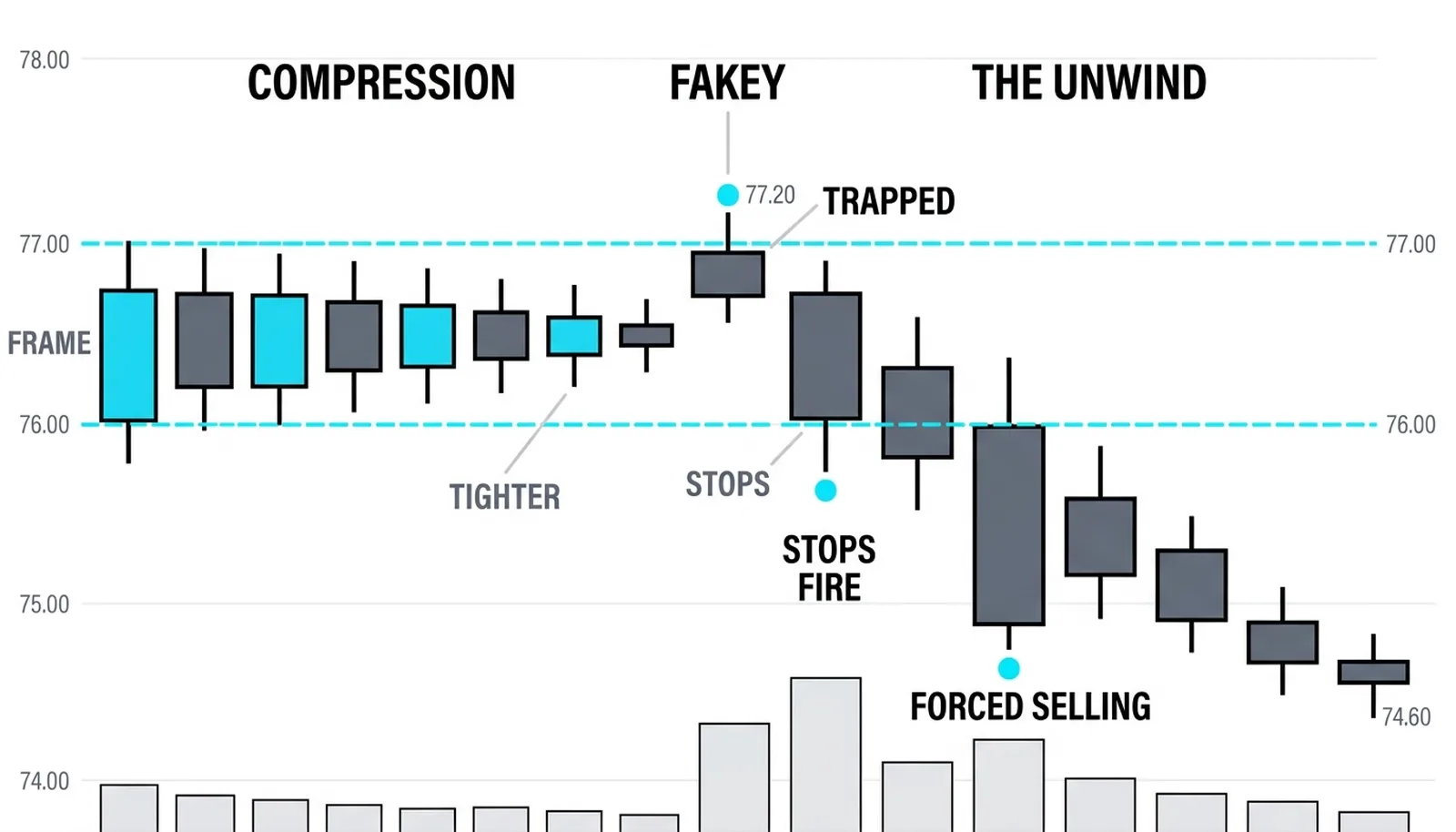
The fakey pays because it creates a built-in source of fuel. Everyone who bought the poke above the frame is underwater the moment the close lands back inside. Their stops sit just below, and their exits are sell orders. When price turns down, those stops fire in a chain, and the trapped crowd's forced selling becomes the downward move.
You are not predicting anything. You are positioning in front of other people's forced exits. That is a much sturdier edge than an opinion about where price should go.
The location matters as much as the shape. A fakey at a well-tested range edge or a clear support-resistance level traps breakout traders at a price that already matters to the market. A fakey in the middle of nowhere traps nobody important. The level gives the trap its size.
The compression matters too. The tighter the inside bars, the more orders cluster at the frame's edges, and the more violent the unwinding when the break fails. Compression loads the spring; the failed break releases it.
When It Is Not a Fakey
First caution, and it is the one that costs accounts. The close back inside is the pattern. A bar that breaks the frame and holds outside is a real breakout. Fading real breakouts because they look like fakeys is how small accounts die. The signal is the rejection, never the poke. If the bar closes beyond the mother bar's edge and the next bar holds there, there is no fakey, and shorting it is fighting a genuine expansion.
Second caution: direction is context. The fakey works best at range edges and after compression, where two-sided trade exists and a failed probe means something. A fakey against a one-sided, one-timeframing trend day is a trader arguing with the only side present. On a strong trend day, a poke above a small inside bar that closes back inside often just pauses before the trend resumes. The trap needs a crowd on both sides to work.
Blunt version: the pattern is the close, and the context is the permission slip. You need both.
The Trap at 91.40
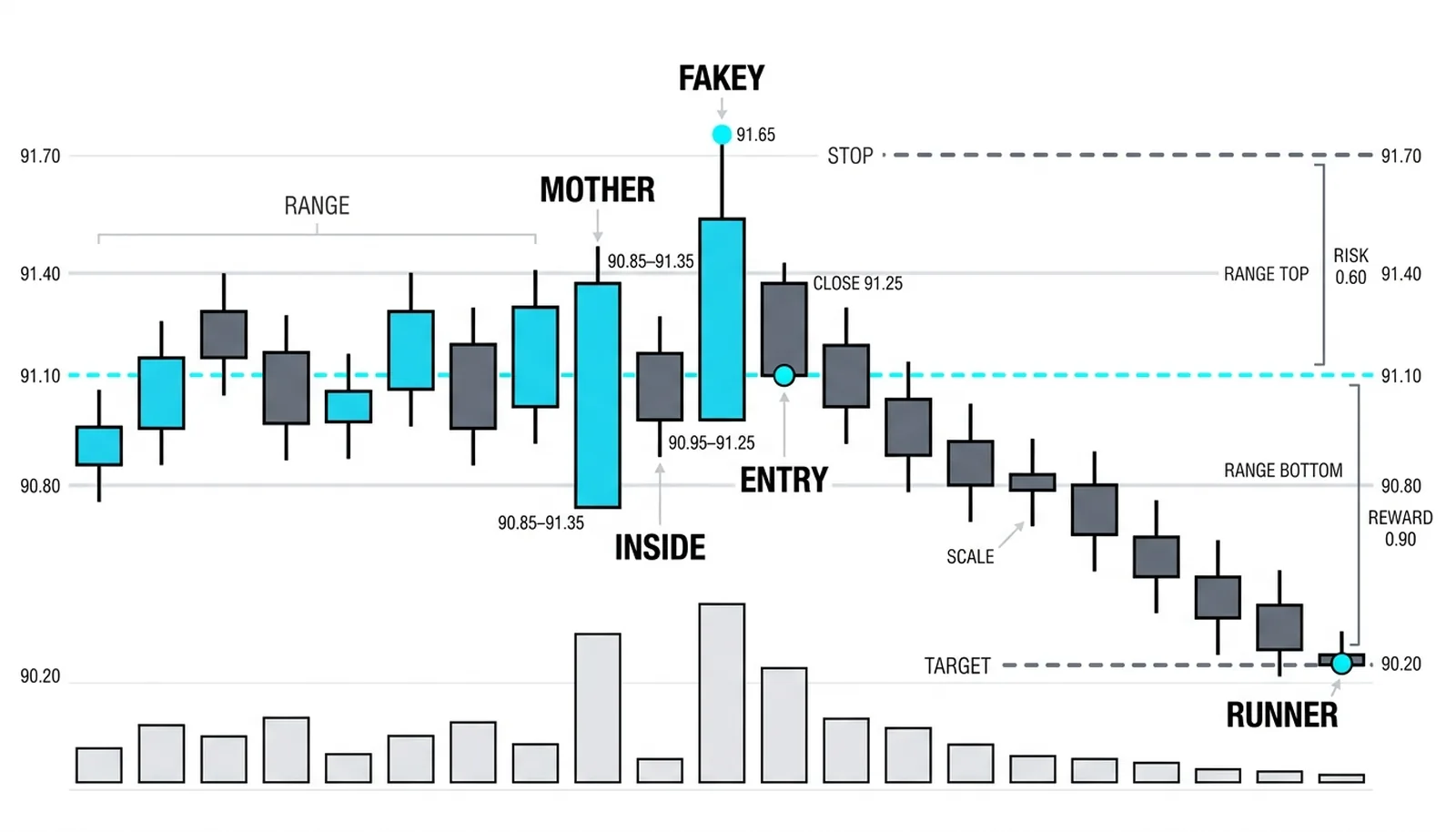
A hypothetical illustration with round numbers. Price has spent two weeks in a range between 90.80 and 91.40. The top of that range has been tested three times.
On the fourth approach, a wide mother bar prints, spanning 90.85 to 91.35. The next bar squeezes inside it, 90.95 to 91.25. Compression, right under the range high.
Then the fakey bar. It opens at 91.30, spikes to 91.65, poking through both the mother bar's high and the range top at 91.40. Breakout buyers pile in above 91.40. Then the bar closes at 91.25, back inside the mother bar's frame. The trap is sprung. Everyone who bought above 91.40 is underwater within one bar.
The conservative trade: short the break back below 91.10, confirming the rejection has follow-through. The stop sits at 91.70, just above the poke high, risking 0.60. The range low at 90.80 is only a 0.30 scalp from the 91.10 entry, so the honest target is the range break itself: a runner toward 90.20 pays 0.90 on the 0.60 risked, about 1.5 times the risk, and the range low is where a first scale makes sense if the market hesitates there.
The failed version matters just as much. Suppose instead the bar after the poke closes at 91.55 and holds outside the frame. The fakey is void. There is no rejection, the breakout is real, and any short taken on the poke exits at the 91.70 stop without argument. The setup gives you the trade and the cancellation in the same definition.
| Sequence step | What prints | The read | The mistake |
|---|---|---|---|
| Mother bar | Wide bar, 90.85 to 91.35 | Conviction sets the frame | Trading the poke without a frame |
| Inside bar | Compression, 90.95 to 91.25 | The coil tightens under the level | Assuming direction early |
| The poke | Spike to 91.65 above 91.40 | The decoy draws breakout buyers | Chasing the break itself |
| Close back inside | Close at 91.25, inside the frame | Rejection confirmed, trap visible | Shorting before the close proves it |
Fakey Questions, Answered
What is a fakey pattern?
A fakey is a false breakout of an inside-bar range: a mother bar sets the frame, at least one inside bar compresses within it, then a bar pokes beyond the mother bar's edge and closes back inside. The close back inside is the signal, and the trapped breakout traders supply the fuel for the move the other way.
Is a fakey the same as a false breakout?
A fakey is one specific species of false breakout, defined by the inside-bar structure that precedes it. False breakout is the broader family; the fakey is the version with a mother bar, a compression, and a measurable frame for stops and targets.
Where does the stop go on a fakey trade?
The stop goes just beyond the extreme of the poke, the high of the fakey bar for a short or the low for a long. In the worked example that was 91.70, above the 91.65 spike. If price takes out that extreme, the rejection has failed and the trade idea is wrong by definition.
Does the fakey work in uptrends?
Yes, but direction flips and context still rules. In an uptrend, the tradable fakey is usually a poke below a mother bar's low that closes back inside, trapping sellers and fueling the resumption higher. Fading a strong trend with a counter-trend fakey is the version that gets traders hurt.
Next in the series, the doji family gets the same treatment: what each shape actually says about indecision, which ones carry information, and which ones are noise wearing a famous name.