Gann Time and Price Squaring: The Count
Time and price squaring is the Gann framework's counting practice: the height of a completed range, measured in points, is counted forward as bars or weeks, and the bar where the count completes is the window where a turn is allowed to arrive. The method fixes the timing in advance. Nothing about the market's speed matters. Only the count matters.

Think of the lap counter at a track, where the race is defined by the count of laps already run and the finish line is fixed before the runners arrive. The squaring works the same way. The range sets the total, the count ticks forward one bar at a time, and the finish line stands in place whether the market hurries or drifts.
The earlier time lessons marked cycles and windows in general terms. This lesson is the Gann version, where the count comes from the range's own height and the window is fixed before the market gets anywhere near it.
Measuring the Range, Counting the Time
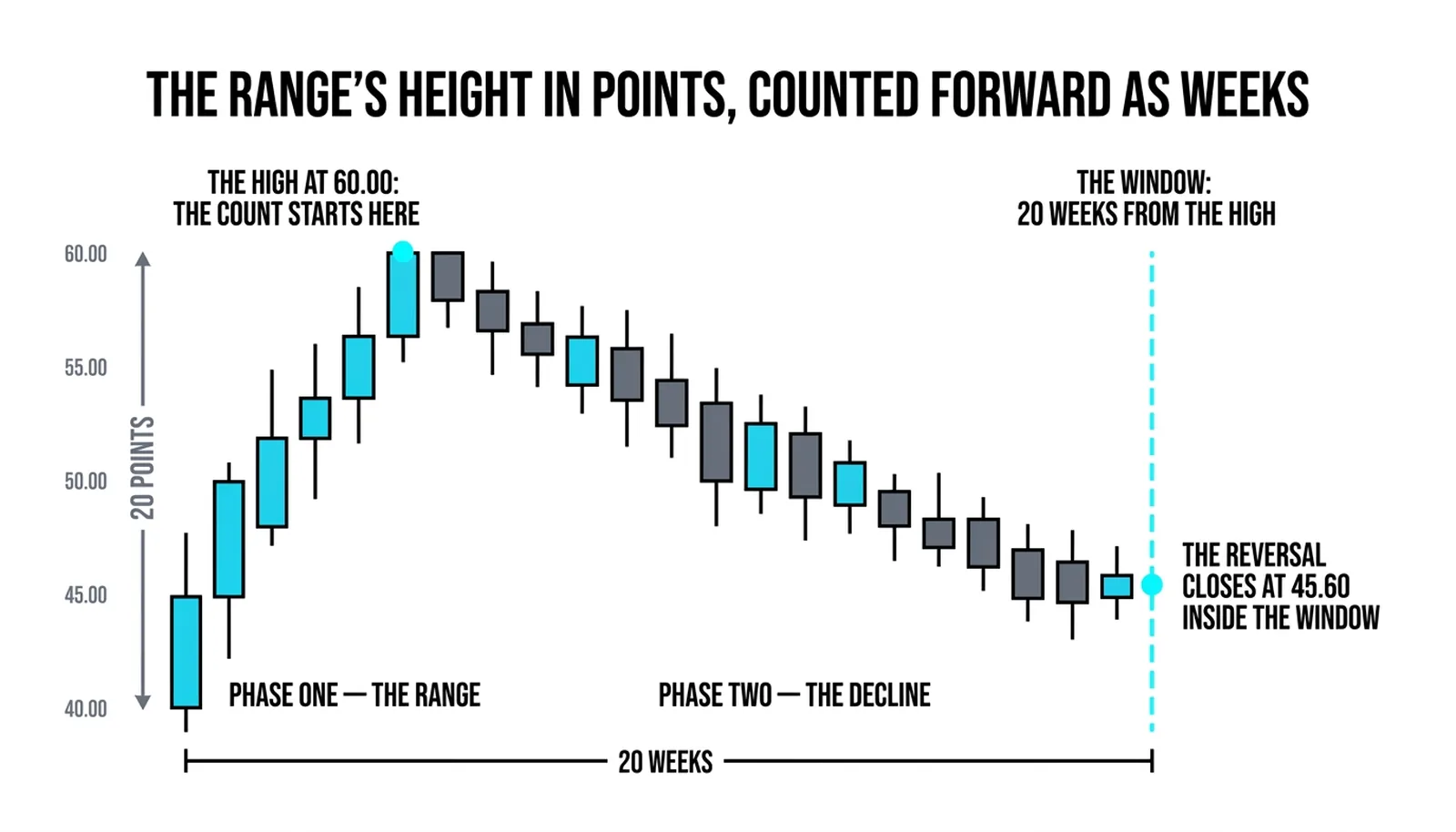
The rule has two steps. Measure the price range of the completed move in points. Then count the same number of time units forward from the high or the low that made the range.
A range of twenty points sets a count of twenty weeks. A range of thirty points on a daily chart sets a count of thirty sessions. The unit matches the chart. The anniversary of price as time is the squaring.
The count always starts from the extreme that completed the range. If a rally topped at a high, the count runs from that high. If a decline bottomed at a low, the count runs from that low. The anchor point is the bar that printed the extreme, not the bar after it.
The week the count completes is the window. Gann treated that anniversary as a point where time and price balance, and where the market earns the right to change direction. The window does not cause the turn. It marks where the turn is permitted.
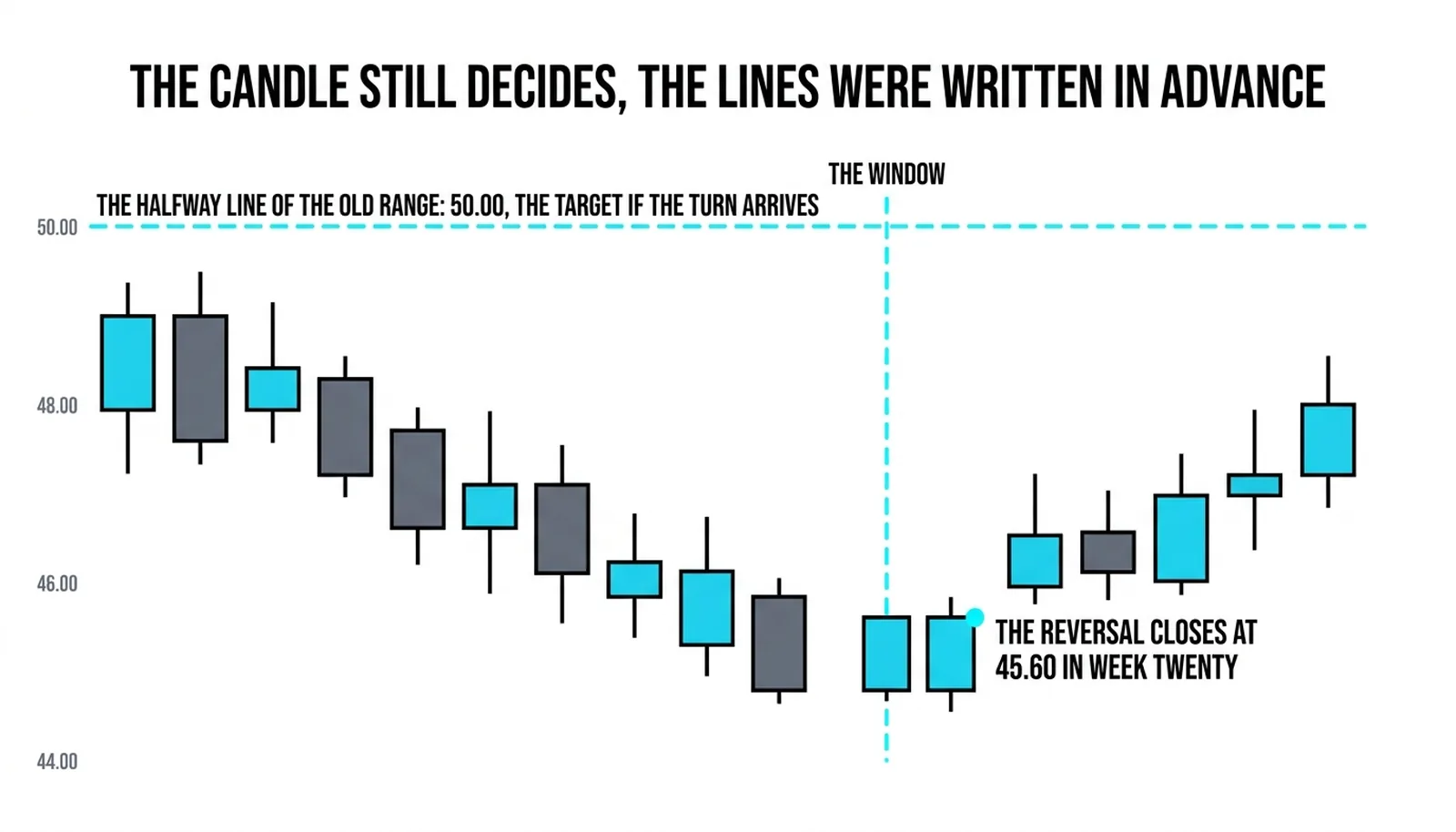
Around the window, the old range keeps working. Its division lines, the halfway mark above all, become the targets if the turn arrives. A market that reverses at a squaring frequently travels back toward the midpoint of the range that set the count. Half of a twenty-point range is ten points, and that line is written on the chart before the window opens.
Other divisions matter less. Quarters and thirds show up in the Gann framework, but the halfway mark carries the most weight in practice. One line, drawn early, watched patiently.
The count is not a signal. It is a schedule. The market still has to print the reversal, and the candle still has to close.
A Window, Not a Switch
A window is not a switch. The count carries no force. Markets square ranges and ignore squarings in roughly equal measure, and no honest reading of the record says otherwise.
The trader who treats the anniversary as a signal without a candle has traded a number instead of a market. The number is fixed. The market is not.
The real use of the count is preparation. Orders planned in advance. Levels written down. The week watched rather than traded blind. When the window opens, the trader already knows the entry condition, the stop location, and the first target, because all three were settled weeks earlier.
The empty window is the normal outcome, not the embarrassing one. Week twenty arrives, no reversal prints, and the decline continues. The count is retired without argument. A window that needs the market to obey is not a window but a wish.
This discipline is what separates the practice from numerology. The squaring proposes a time and a place. Price confirms or refuses. The trader accepts the outcome either way, because the edge was never in the count itself. The edge is in arriving prepared at a location where preparation pays.
Some traders stack squarings, counting from several ranges at once and watching where the counts cluster. That refinement changes nothing about the rule. The cluster is still a window. The candle still decides.
The Window at Week Twenty
Every number in this example is invented and round, framed as an illustration of the mechanics.
A completed advance runs from 40.00 to 60.00. The range measures twenty points. The count of twenty weeks runs forward from the week the high at 60.00 printed.
The halfway line of the old range sits at 50.00. That line is drawn on the chart in week one of the count, long before it matters.
The market declines through the count. In week nineteen, price stands at 44.80, still falling. Nothing has happened yet. The count has only marked the calendar.
In week twenty, the window opens. A reversal candle prints and closes at 45.60. The squaring proposed the time. The candle confirmed the turn. Only now does the trade exist.
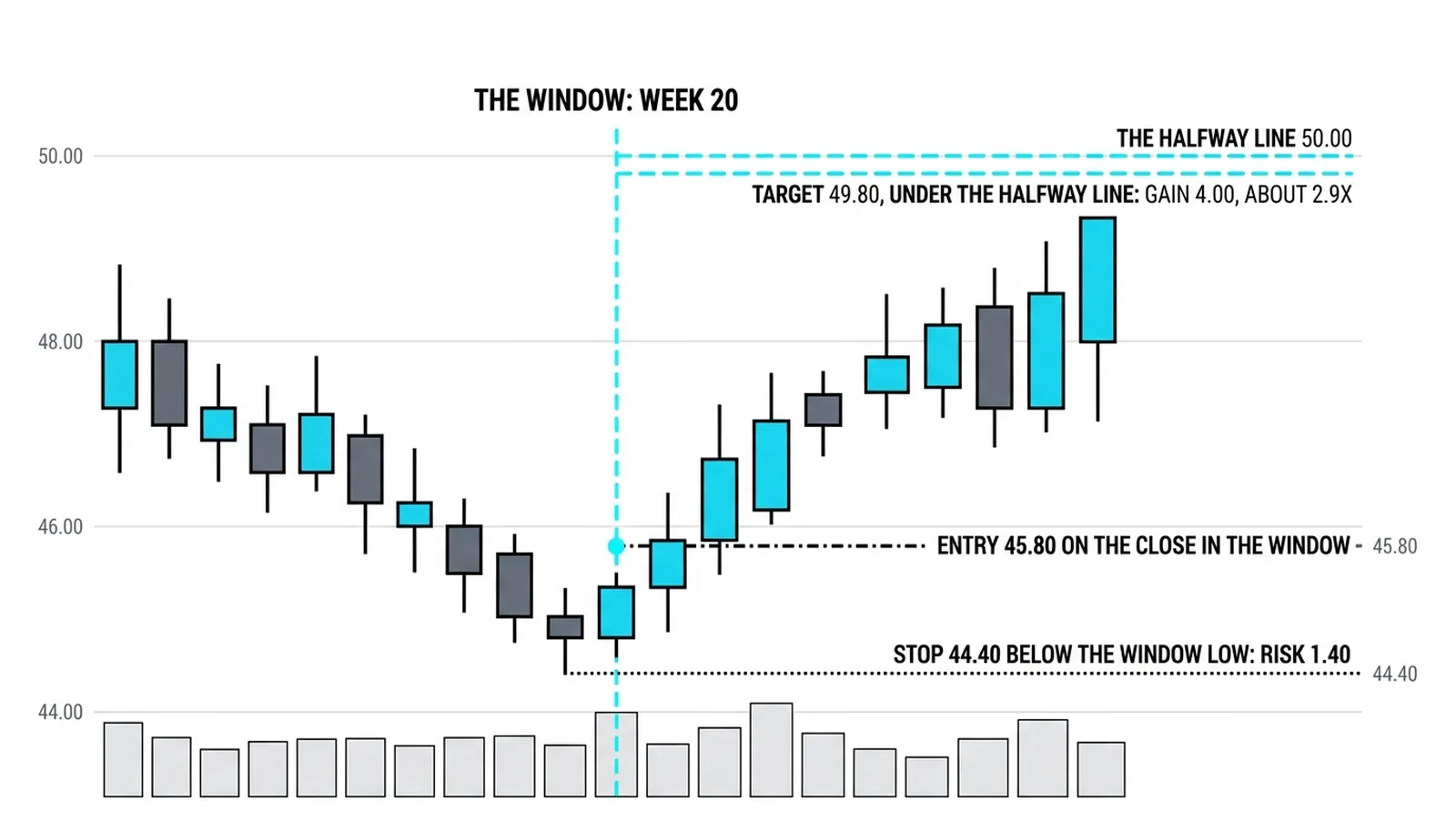
The long is taken at 45.80 on the next bar. The stop sits at 44.40, below the low the window produced. The risk is 1.40 per unit.
The first target is 49.80, just under the halfway line of the old range at 50.00. Targets sit in front of the level, not on it, because orders cluster at the round line and fills come easier a step early.
The market reaches the target. The gain is 4.00 against a risk of 1.40, about 2.9 times the risk. The count supplied the timing, the halfway line supplied the target, and the candle supplied the permission.
Now the failed version, because it happens half the time. Week twenty arrives and prints no reversal. The decline runs on to 43.20. The count is retired without argument. No trade was taken, because no candle ever confirmed. The preparation cost nothing. The empty window cost nothing. That asymmetry is the economic case for the method.
| The Step | What Is Measured | What It Fixes in Advance | What It Does Not Promise |
|---|---|---|---|
| Measure the range | Height of the completed move in points | The size of the count | That the range matters to the future |
| Run the count | Time units forward from the extreme | The week the window opens | That the market will be there |
| Draw the divisions | The halfway line of the old range | The first target if a turn arrives | That price will reach the line |
| Wait for the candle | The reversal close inside the window | The entry condition and the stop | That the candle will ever print |
Squaring Questions, Answered
What is squaring time and price?
Squaring time and price is the Gann framework's practice of measuring a completed range in points and counting that same number forward in bars or weeks. The bar where the count completes is the anniversary, the point where the range's height in price equals its projection in time. That anniversary marks a window where a turn is allowed to arrive.
How do you count a Gann squaring?
Count from the extreme that completed the range. If a rally topped at a high, count forward from that high's bar. If a decline bottomed at a low, count from that low's bar. Use the chart's own unit: weeks on a weekly chart, sessions on a daily chart. A twenty-point range produces a count of twenty units, and the twentieth bar is the window.
Does every range square on schedule?
No. Markets square ranges and ignore squarings in roughly equal measure. Many windows pass with no reversal at all, and the decline or rally simply continues. The count is retired without argument when that happens. The method pays through preparation at the windows that do work, not through obedience from the ones that do not.
What happens when the window passes without a turn?
Nothing, and that is the correct answer. No candle printed, so no trade existed. The count is set aside, the levels are kept or redrawn, and the trader moves to the next setup. The cost of an empty window is the attention spent watching it, nothing more. A window that needs the market to obey is not a window but a wish.
The count closes Level 6. The geometry that began with clusters under the zones, ran through the harmonic ancestry, and ended with the Gann framework's angled lines now rests on a single habit: fix what can be fixed in advance, and let the candle decide the rest. Level 9 is already open, where volume takes over the questioning, and the first two lessons on why volume can be trusted are waiting.