Central Bank Meetings: Prepare and Position
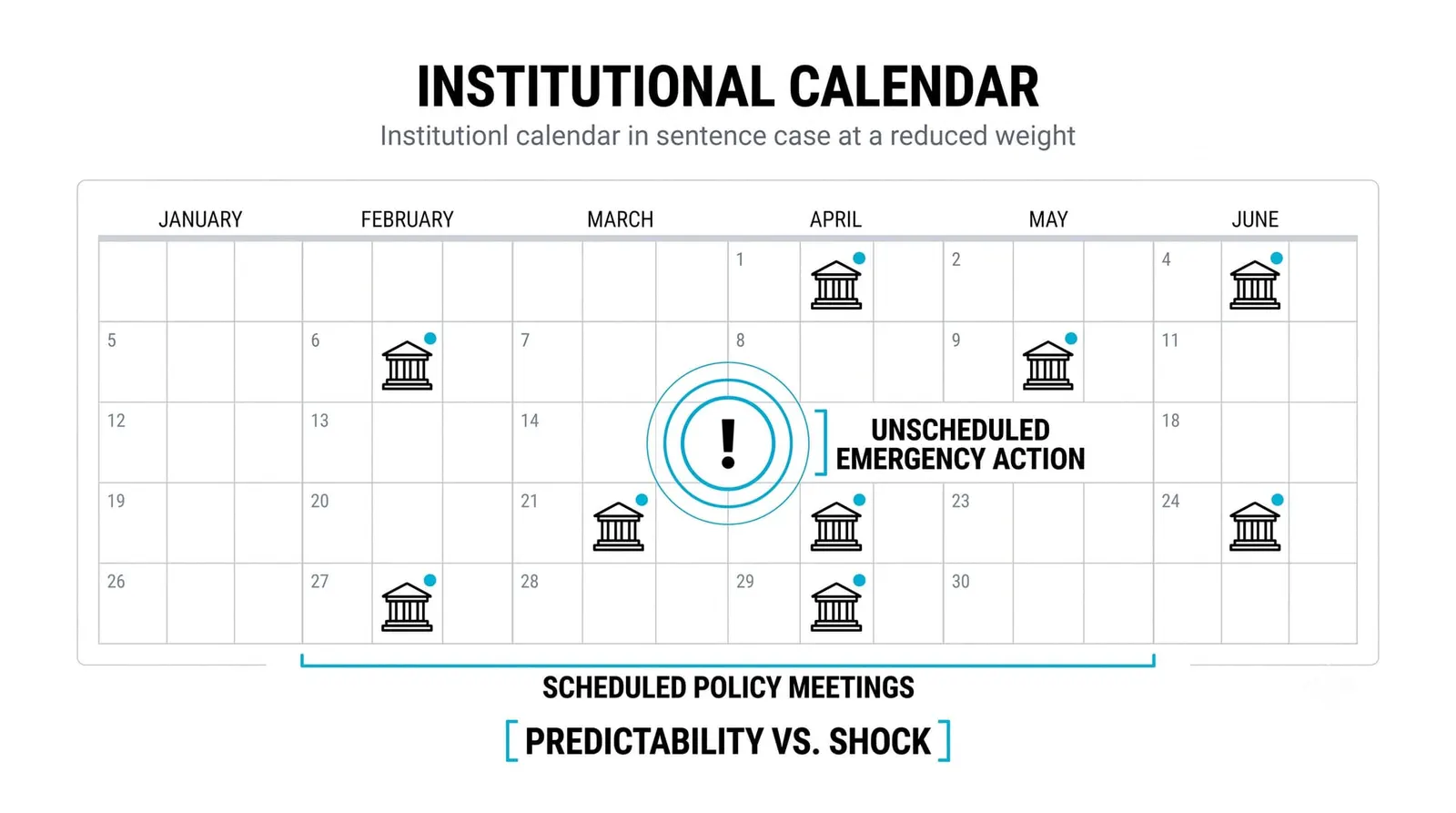
Central bank meetings are roughly eight scheduled gatherings per year for each major bank, with dates published months to a year in advance, and they are the fixed points around which traders position. The reason is simple: a meeting concentrates the risk of a rate surprise, a statement shift, and a guidance change into one known day. Rather than risk arriving randomly, it arrives on schedule. You can see it coming from far away.

Think of these meetings as holidays for volatility: the dates are printed far ahead, and the whole market plans its travel around them. Liquidity thins before the event, positioning builds in the days prior, and the move itself usually happens in a compressed window. If you trade currencies at all, the meeting calendar is not optional reading. It is the skeleton of your trading year.
The previous lessons covered rate decisions and forward guidance as events in themselves. This lesson is about where those events get scheduled, and how to organize your exposure around the dates. The news trading protocols from the earlier cluster also apply here, bank by bank. The discipline is the same; only the institution changes.
How the Meeting Calendar Is Built
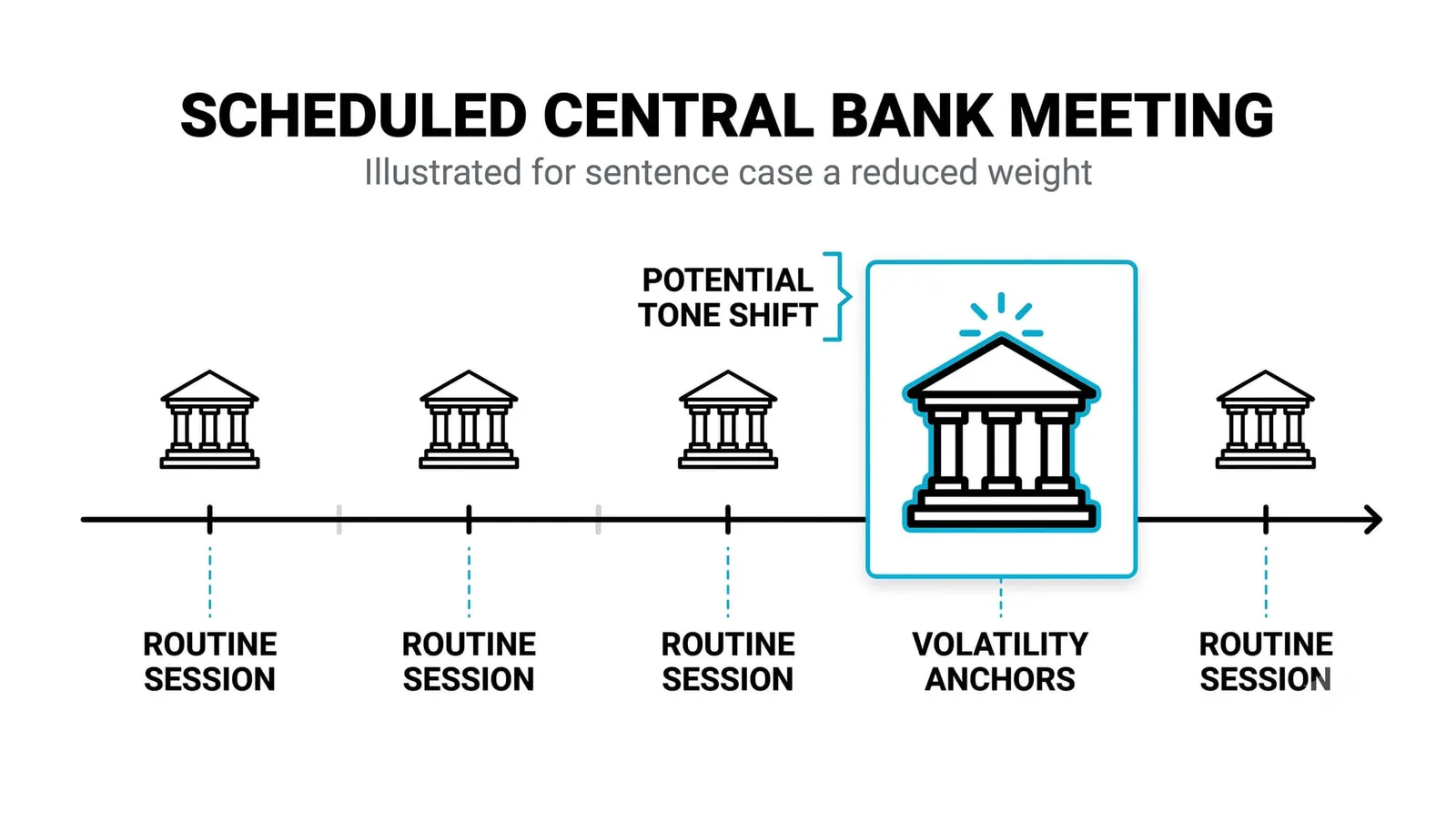
Each major central bank sets its own schedule and publishes it well in advance. The Federal Reserve, the European Central Bank, the Bank of England, and the Bank of Japan each meet on their own rhythm, typically six to ten times a year depending on the bank. The dates for the following year are usually public before the current year ends.
Most banks follow a repeating structure. There is a rate decision, a written statement released at the same moment, and, for many meetings, a press conference shortly after. Some meetings also carry updated economic projections, which adds another layer of information. Not every meeting is equal in format, and the calendar usually marks which ones include the fuller package.
One structural feature matters for traders: the big banks rarely meet on the same day. Their schedules are independent, so the calendar spreads decision risk across the year rather than stacking it. In practice this means most weeks contain at most one major decision, and the occasional collision week stands out. You can plan around that shape.
Build the habit of checking the calendar weekly, for your home currency and for both sides of every pair you trade. A dollar position is exposed to the Fed and to whatever bank sits on the other side of the pair.
What Happens on Meeting Day
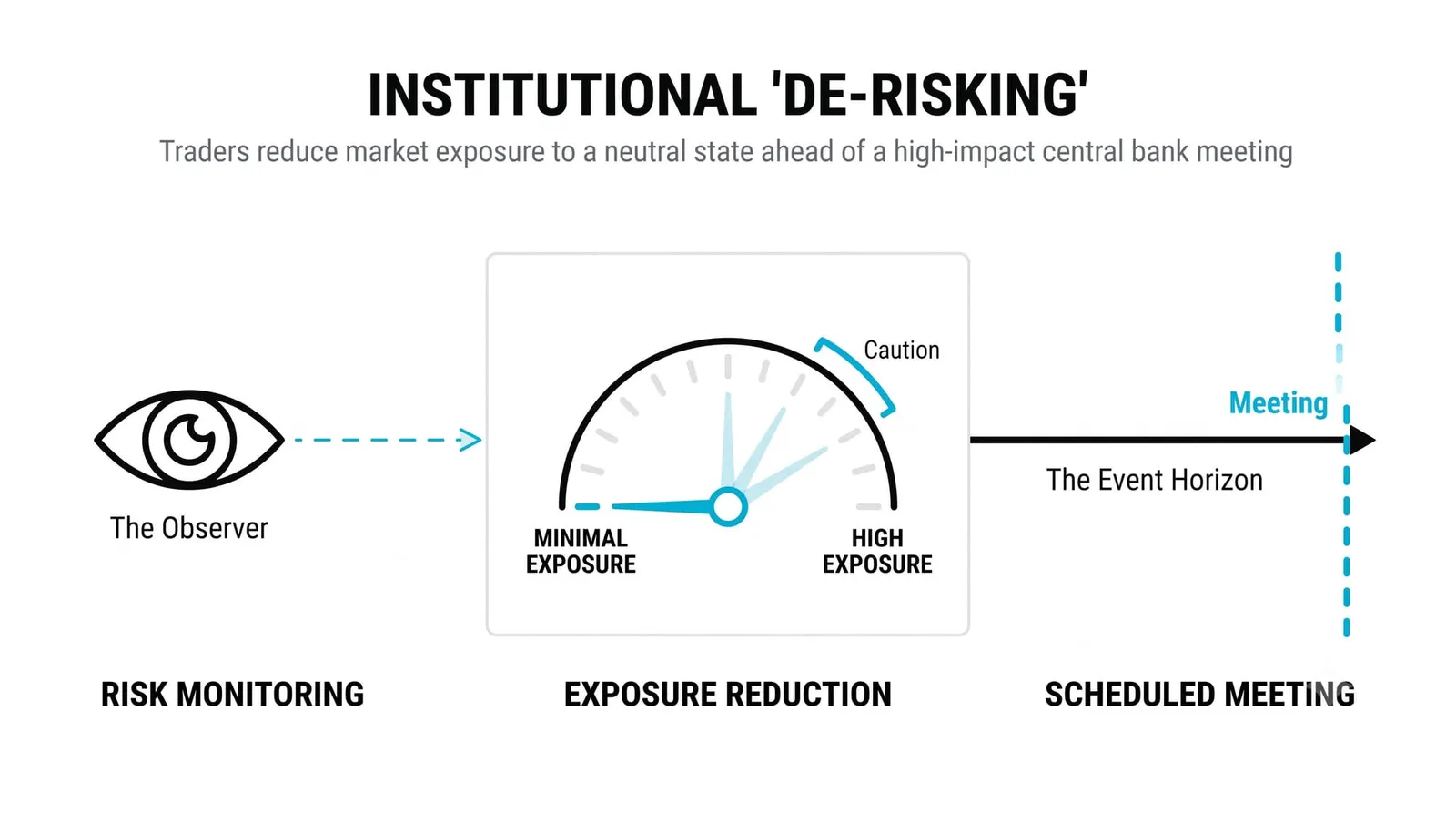
The day follows a recognizable sequence. The rate decision and statement drop together at a fixed, published time. Algorithms and human traders read the statement within seconds, and the first price move happens almost immediately. Then, where a press conference follows, a second wave of movement arrives as the central bank head answers questions and the tone gets interpreted in real time.
Volatility concentrates in two windows: the minutes around the statement release, and the stretch of the press conference. Outside those windows, meeting days can be strangely quiet. Many traders describe the hours before the release as dead, because nobody wants to commit ahead of the number.
The same meeting matters differently to different pairs. A European Central Bank decision hits EUR/USD directly, EUR/JPY hard, and AUD/NZD barely at all. A Bank of Japan decision can move every yen pair at once while leaving a euro-sterling trader untouched. Your exposure is defined by the currencies in your book, not by the size of the headline.
One blunt truth: the initial spike is often the worst price of the day. The first reaction is frequently reversed or extended during the press conference, which is why experienced traders treat the statement move as information, not as a finish line.
Positioning Before, During, and After
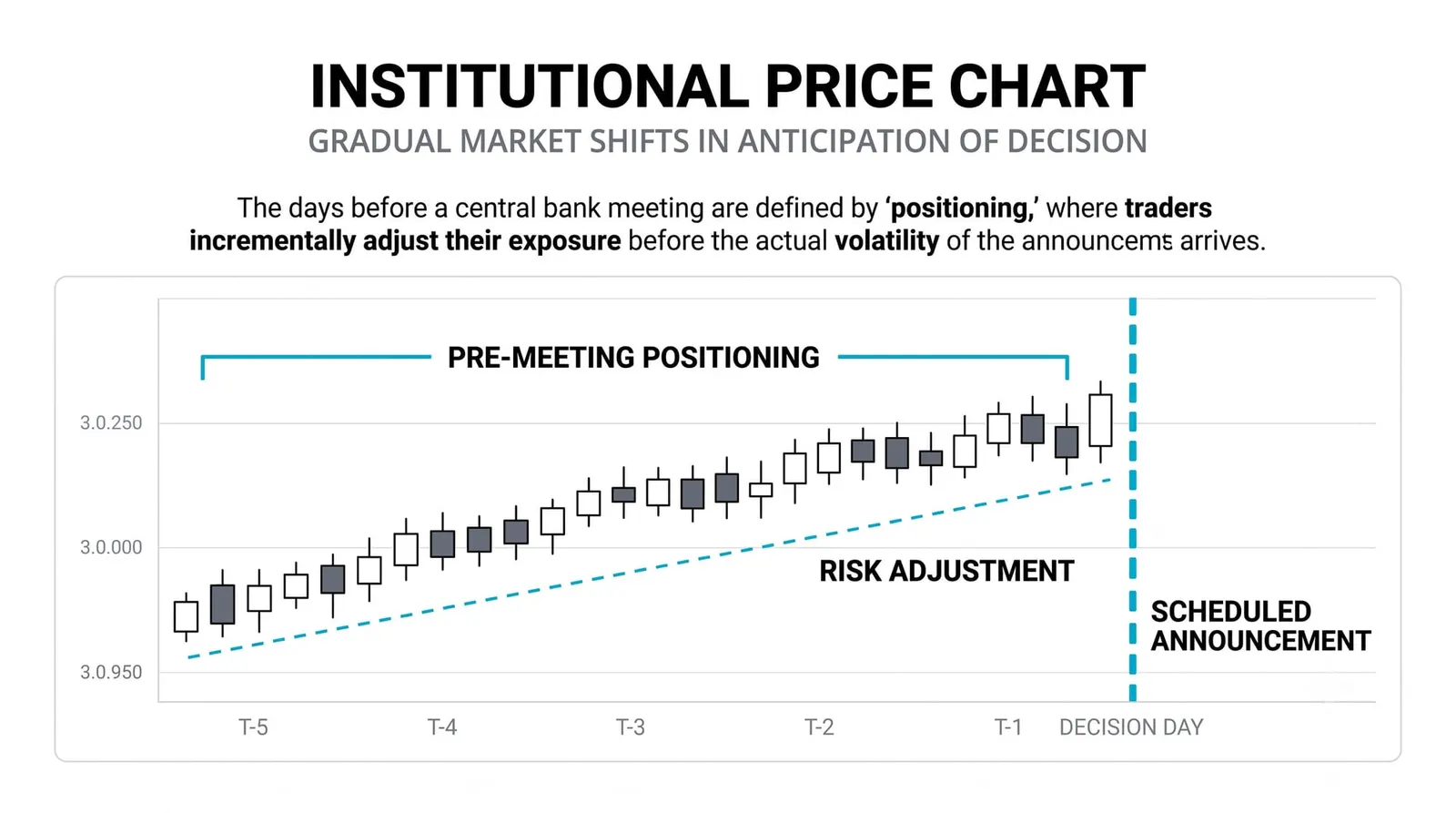
Decide your exposure before the day arrives, not during it. The middle of a release is the worst possible moment to be making plan-level decisions, because spreads widen, slippage grows, and your emotions are loudest. The choice is made in advance: hold through, reduce, or stand aside.
Holding through a meeting is a legitimate choice when the position is sized so that a full adverse move is survivable. Standing aside is equally legitimate when the outcome is genuinely uncertain and your edge does not depend on the result. What is not a strategy is holding a full-size position while hoping the statement goes your way.
After the dust settles, read the retest. If the market spikes on the statement, pulls back, and then holds the new level, the move has acceptance behind it. If the spike fades completely within a day, the meeting delivered noise rather than signal. The day after the meeting often tells you more than the meeting itself.
One pattern deserves attention: the second meeting of a shifting cycle often matters more than the first. The first move in a new direction can be dismissed as a one-off. When the next meeting confirms it, the market reprices the whole path rather than the single step. Confirmation moves tend to be larger and more durable than the initial surprise.
When Meetings Collide: Clusters and Stacked Risk
Some weeks pack two or three major banks into a few days. These clusters change the risk math. Each meeting is a separate coin flip on your book, and the outcomes can compound rather than offset. A trader who survives Tuesday's decision still carries the position into Thursday's, often with a profit or loss that distorts judgment for the next one.
Correlated positions make stacked weeks worse than the sum of their parts. If you are long the dollar against three different currencies, and three banks meet in one week, you do not have three independent bets. You have one large dollar bet being struck three times. A single dollar-bullish surprise can lift all three, and a dovish one can hit all three at once.
The practical response is to treat cluster weeks as a single risk event. Total your exposure across every pair that shares a currency, size for the combined scenario, and accept smaller positions than you would carry in a quiet week. The calendar tells you these weeks are coming months in advance. There is no excuse for being surprised by them.
One Week, Three Banks
Imagine a purely hypothetical trader who is long currency A against currency B, with a position sized so a one percent adverse move costs 100 units of account equity. In one week, three banks meet: currency A's bank on Tuesday, currency B's bank on Thursday, and a commodity bank on Friday whose currency correlates loosely with currency A.
Tuesday brings a hold from currency A's bank, but with a dovish tone suggesting cuts are being discussed. The long leg weakens, and the position loses roughly 60 units before stabilizing. The trader holds, because the loss is inside the pre-set tolerance.
Thursday, currency B's bank also holds, but its statement leans hawkish. Currency B strengthens, and since the trader is short B, this is a second hit: another 50 units against the position. The two decisions were independent events, yet both landed on the same trade in the same direction. The combined loss is now around 110 units, larger than the single-meeting risk the position was sized for.
Friday, the commodity bank surprises with a cut. The correlated currency sells off and drags currency A down with it, adding another 30 units of pain through correlation alone, on a bank the trader does not even trade directly. The week's total damage is roughly 140 units.
The lesson is in the arithmetic. The week's risk was closer to the sum of three decisions than to the average of three. Sizing for one meeting while three are on the calendar is under-sizing by a factor of three.
| Event | Decision Risk | Trader's Exposure |
|---|---|---|
| Tuesday meeting (currency A's bank) | Hold with dovish tone; cut talk enters the statement | Long leg weakens; roughly 60 units lost |
| Thursday meeting (currency B's bank) | Hold with hawkish lean; tightening stays on the table | Short leg strengthens against the trader; roughly 50 units lost |
| Friday meeting (commodity bank) | Surprise cut; correlated currency sells off | Correlation drag on currency A; roughly 30 units lost |
| The week as a whole | Three independent decisions, one direction of pain | Combined loss near 140 units; risk summed, not averaged |
Central Bank Meetings, Answered
How many times a year does a central bank meet?
Most major central banks hold scheduled policy meetings six to ten times per year, with eight being a common rhythm. The exact count is set by each bank and published in advance, so you can check the number for any bank you trade.
Why do some meetings matter more than others?
Meetings matter more when they carry updated projections, when policy is near a turning point, or when the market is split on the outcome. A meeting where the decision is nearly certain produces little movement, because the expected result is already in the price.
Should you close positions before a central bank meeting?
There is no universal rule; the right answer depends on whether your position is sized to survive a full adverse move. If it is, holding is a defensible choice. If it is not, reducing or closing before the release is the honest option, and it should be decided before the day arrives.
Where can you find the meeting calendar?
Each central bank publishes its own schedule on its official website, often a year or more ahead. Standard economic calendars aggregate these dates alongside data releases, so a single weekly check covers every bank relevant to your book.
With the calendar structure in place, the next layer is the people inside the room: how central bank officials speak between meetings, and how to read the speeches, minutes, and interviews that fill the gaps between these fixed dates.