ATR Stops and Position Sizing
ATR stops and position sizing turn the market's own turbulence into the two numbers that protect an account: how far the stop sits from entry, and how large the position may be. The ATR average true range sets the first, the risk budget sets the second, and the pair works because both scale with the market you are actually trading instead of a rule invented for some other market.

A seatbelt does this in a car. At a crawl it barely locks; on the highway it gives you room while still catching you. The restraint adapts to the speed because the danger scales with it. Fixed-price protection does the opposite: the same 50-cent stop on a quiet market is mostly noise, and on a violent market it is inside the first minute's travel. The stop has to breathe with the market or it protects nothing.
This lesson builds on the ATR explainer and connects to the account-level work in the risk per trade lesson; here the subject is the trade-level math.
Why Fixed-Price Stops Fail
Put a 1-point stop on a market whose average true range is 2 and the stop lives inside one ordinary bar. It will be hit by noise, repeatedly, and every one of those hits is a real loss paid to randomness. Widen the same stop to protect against the storm market whose ATR runs 5 and 1 point is not a stop at all. One number cannot serve both markets, because the noise floor is different.
ATR measures that noise floor directly, which is why volatility-based stops outperform any fixed distance across changing conditions. The stop stops pretending the market will accommodate it, and starts sitting where the market's own travel says protection actually begins.

The Initial Stop: k Times ATR
The standard recipe: place the stop at a multiple of ATR away from entry. Two ATR below a long entry is the common starting point, far enough out that ordinary bar travel does not reach it, close enough that a real failure does not cost a fortune. A practice note from day trading practice: put the 14-period ATR on the chart, double the current value, and treat that as the minimum stop distance, then adjust for nearby structure. The lineage is old: J. The original ATR/RSI framework introduced volatility stops alongside ATR itself, and the idea has barely changed since, because the problem it solves has not.
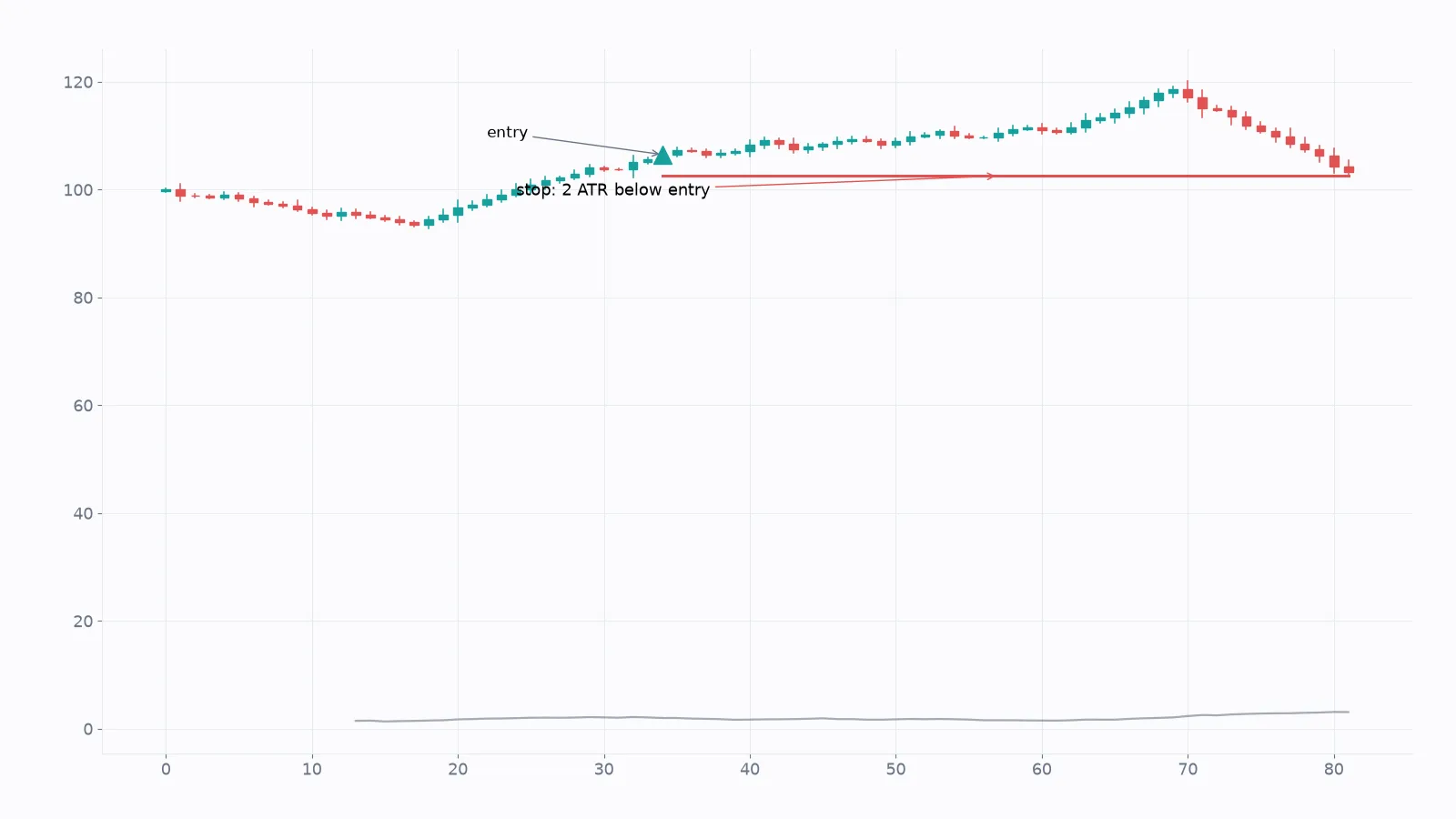
Structure still outranks the formula. If a two-ATR stop lands in the middle of open space but a swing low sits three ATR away, the swing low is where the trade idea dies, and the stop belongs there. ATR sets the minimum sane distance; the market's own levels decide the rest. When the two disagree badly, the trade size shrinks, which is the next section.

The Trailing Exit: The Chandelier
Exits get the same treatment. Chuck LeBeau's chandelier exit trails a stop at the highest high since entry minus three ATR, ratcheting up as new highs print and never backing off. It hangs from the highest point like the fixture it is named after, and it gives a trending trade exactly as much room as the market's turbulence justifies, no more. When the trend finally rolls over, the trail is there to collect the profit.
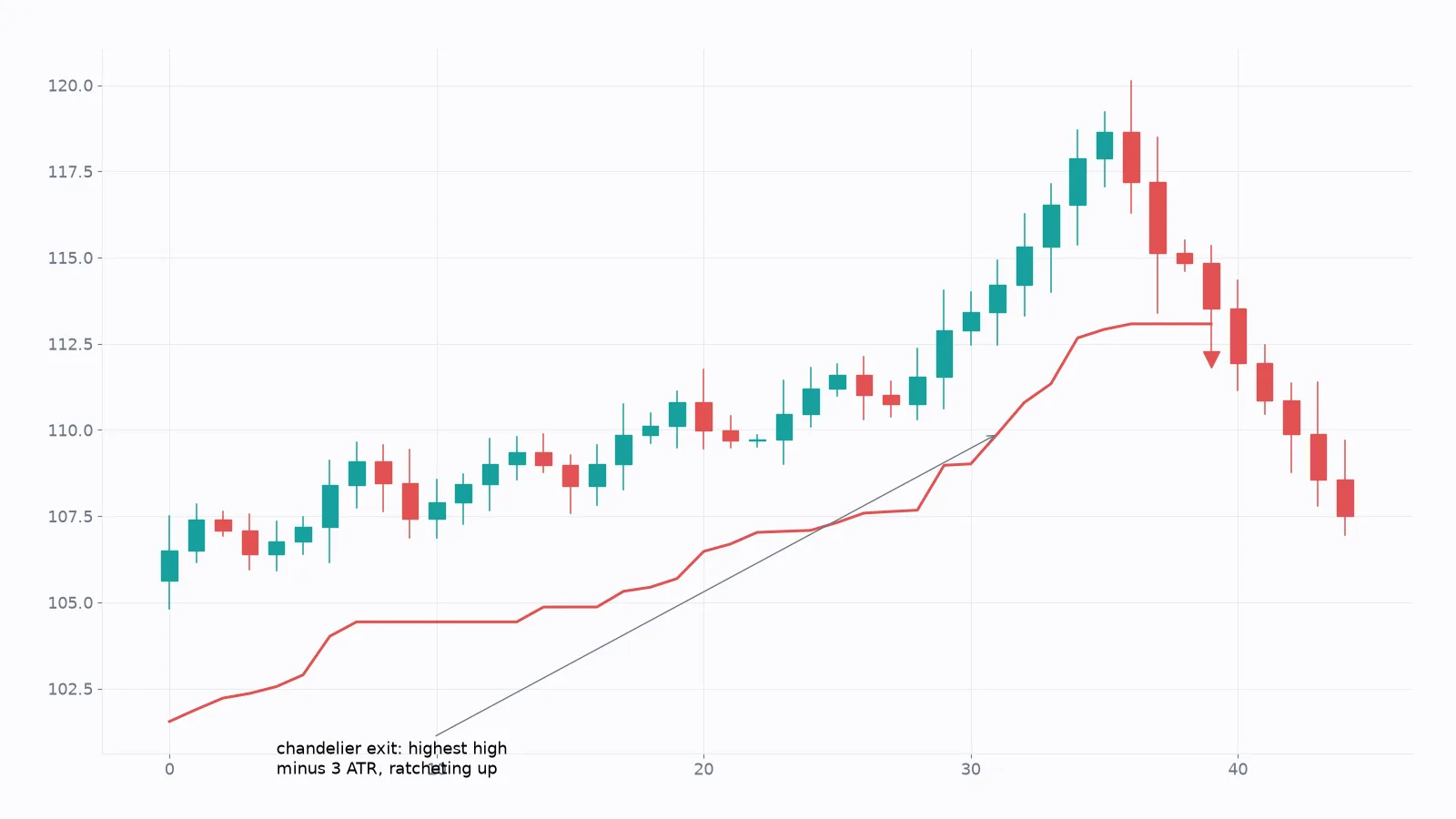
The parabolic SAR covered earlier in this level is the same family: a volatility-scaled trailing stop that the indicator's original design built into an entry system. The chandelier keeps the trailing logic and leaves the entry to you, which most traders prefer.

Sizing: The Math That Makes It Honest
The stop distance and the dollar risk together decide the position size. The formula has one line: shares equal dollars at risk divided by the stop distance. A trader risking 100 dollars on a 20-dollar market with an ATR of 0.4 places a 2-ATR stop 0.8 away, so the position is 100 over 0.8, which is 125 shares. The same trader, same 100 dollars, takes the identical setup on a 200-dollar market with an ATR of 4, stop distance 8: the position is 12.5 shares.
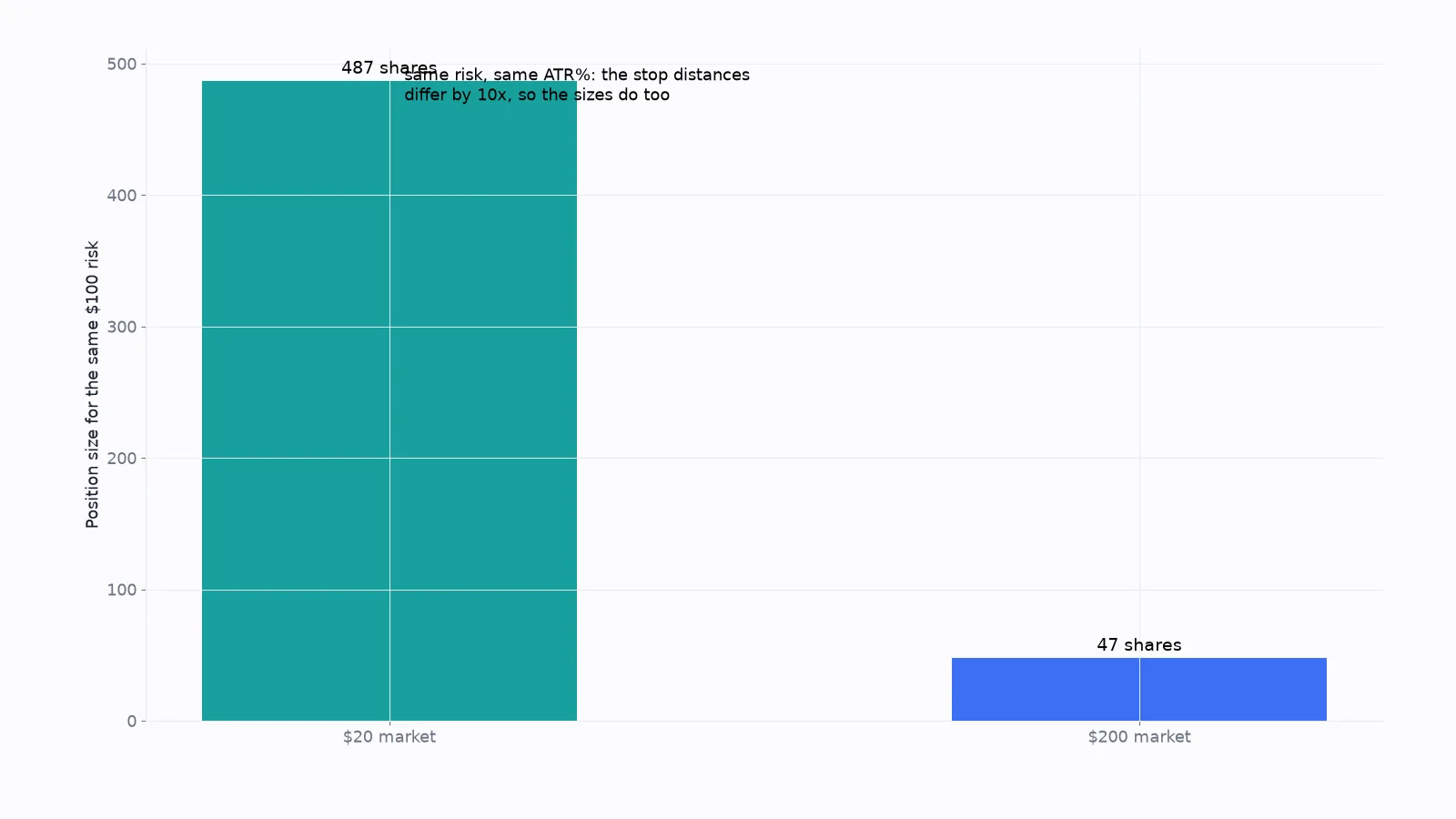
Both positions risk exactly 100 dollars, which is the point. The percentage move being traded is the same, the turbulence being endured is the same, and the loss if wrong is the same. Raw share counts differ by a factor of ten because the markets differ, and the ATR math is what keeps the risk from differing with them. Traders who size by share count or by gut feel across markets are quietly running ten times the risk on half of their book, and the sizing formula is the discipline that prevents it.
One Trade, Sized
Round numbers, all hypothetical, one full trade. A pullback entry fills at 20.40 on the 20-dollar market, ATR 0.4. Initial stop: 2 ATR below, at 19.60, a distance of 0.8. Risk budget: 100 dollars. Size: 125 shares. Worst case if the stop fills exactly: 125 times 0.8, which is 100 dollars, the budget, no more.
The trend runs for three weeks, printing highs at 22, 23.2, 24.1, and the chandelier trail follows at 3 ATR below each new high. When the pullback finally reaches the trail near 23.4, the exit fills there: 3 points over entry, 300 dollars on a 100-dollar risk. The trade never needed a target; the trail and the sizing math did all the work, and the account saw exactly the risk it signed up for at every moment.
| Stop approach | Where it fits | How it fails |
|---|---|---|
| Fixed price distance | Almost never; occasionally inside one quiet market | Noise on wild markets, too tight on calm ones |
| Swing structure | Where the trade idea dies; the primary placement | Distance varies with structure, so risk needs the sizing formula anyway |
| 2 ATR from entry | Initial stop when no structure is nearby; the sanity minimum | In a storm, 2 ATR is a wide dollar risk unless size shrinks |
| Chandelier, 3 ATR trail | Exits for trend trades that are already working | Always gives back the last stretch; it is an exit, not a target |
ATR Stops and Sizing, Answered
How do I set a stop loss with ATR?
Take the current ATR, multiply by a chosen multiple, and place the stop that far from entry, two multiples being the common starting point for initial stops. Then check structure: if a swing point sits beyond the ATR distance, use the structure, because that is where the trade idea is actually wrong. If structure is closer, use structure and shrink the size.
What is the chandelier exit?
A trailing stop from Chuck LeBeau: the highest high since entry minus three ATR, ratcheting up with each new high and never loosening. It gives a winning trade exactly as much room as current turbulence justifies and collects the profit when the trend rolls over.
How does ATR position sizing work?
Divide the dollars you are willing to lose by the stop distance. A 100-dollar risk with a 0.8 stop distance is 125 shares; the same risk with an 8-point stop is 12.5 shares. Both positions lose the same amount at their stops, which is what makes results comparable across markets with wildly different prices and turbulence.
Does a wider ATR stop mean more risk?
Only if size stays fixed. The sizing formula converts a wider stop into a smaller position, so the dollars at risk stay where the risk budget set them. The risk lives in the entry-to-stop distance times the size, and the formula holds that product constant while the market's turbulence moves the pieces.