Market Orders vs Limit Orders, Explained
A market order buys or sells immediately at whatever price the book currently offers, while a limit order fills only at your price or better and may never fill at all. That is the subject in full: two guarantees, and you get to pick one. Certainty of execution, or certainty of price.

Think of it as cab versus curb: you can take the first cab that stops and pay whatever the meter says, or you can name your fare and wait on the curb until a driver accepts it. One way you always ride. The other way you always keep your price.
The previous lesson covered the bid, the ask, and how fills actually happen inside the book. This lesson covers the two order types that walk into that machine, and how to pick between them without paying more than you intended.
The Market Order: Now, at Whatever It Costs
A market order is an instruction to fill right now, against whatever is currently resting on the other side of the book. You are telling the exchange: take me in or out, price is secondary.
The small print is slippage. The price you see on screen is the price of the best queue, and your fill is whatever you actually get once your order arrives. In a deep, liquid name with a small size, the gap is often a tick or nothing at all. In a thin name or a fast tape, it can be far worse.
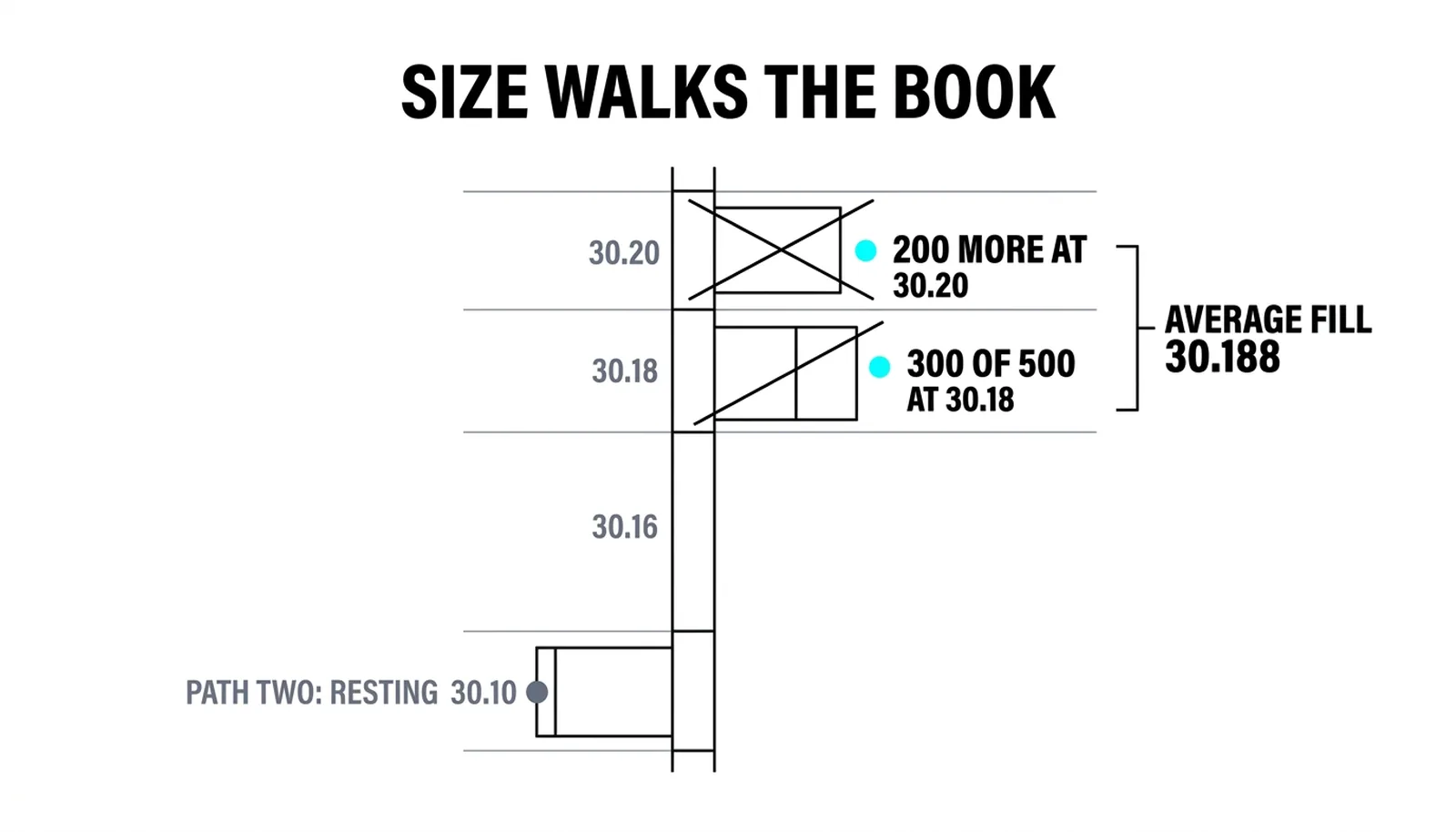
Size is the hidden variable. If you send a market order bigger than the best queue, the order walks the book. It consumes the top level, then the next, then the next, filling across several prices. Your average fill drifts away from the screen price with every level you eat through.
Blunt truth: a market order is you paying for speed with money you cannot see in advance.
That cost is sometimes worth it. When being out matters more than a tick, when a position is going wrong and the exit is the priority, the market order is the honest tool. You are buying a guaranteed exit, and the price of that guarantee is whatever the book demands.
The Limit Order: My Price, Maybe
A limit order is an instruction with a ceiling or a floor attached. Buy at this price or lower, sell at this price or higher. If the market never trades there, nothing happens.
When you place one, it rests in the book as visible liquidity. Your order becomes part of the queue that other traders trade against. You stop being the one who takes prices and become one of the prices being taken.
Order flow analysis puts the relationship cleanly: resting limit orders are the book's liquidity, while market orders are its only active force. One side waits and offers, the other side arrives and consumes. Every trade ever printed is one of each meeting in the middle.
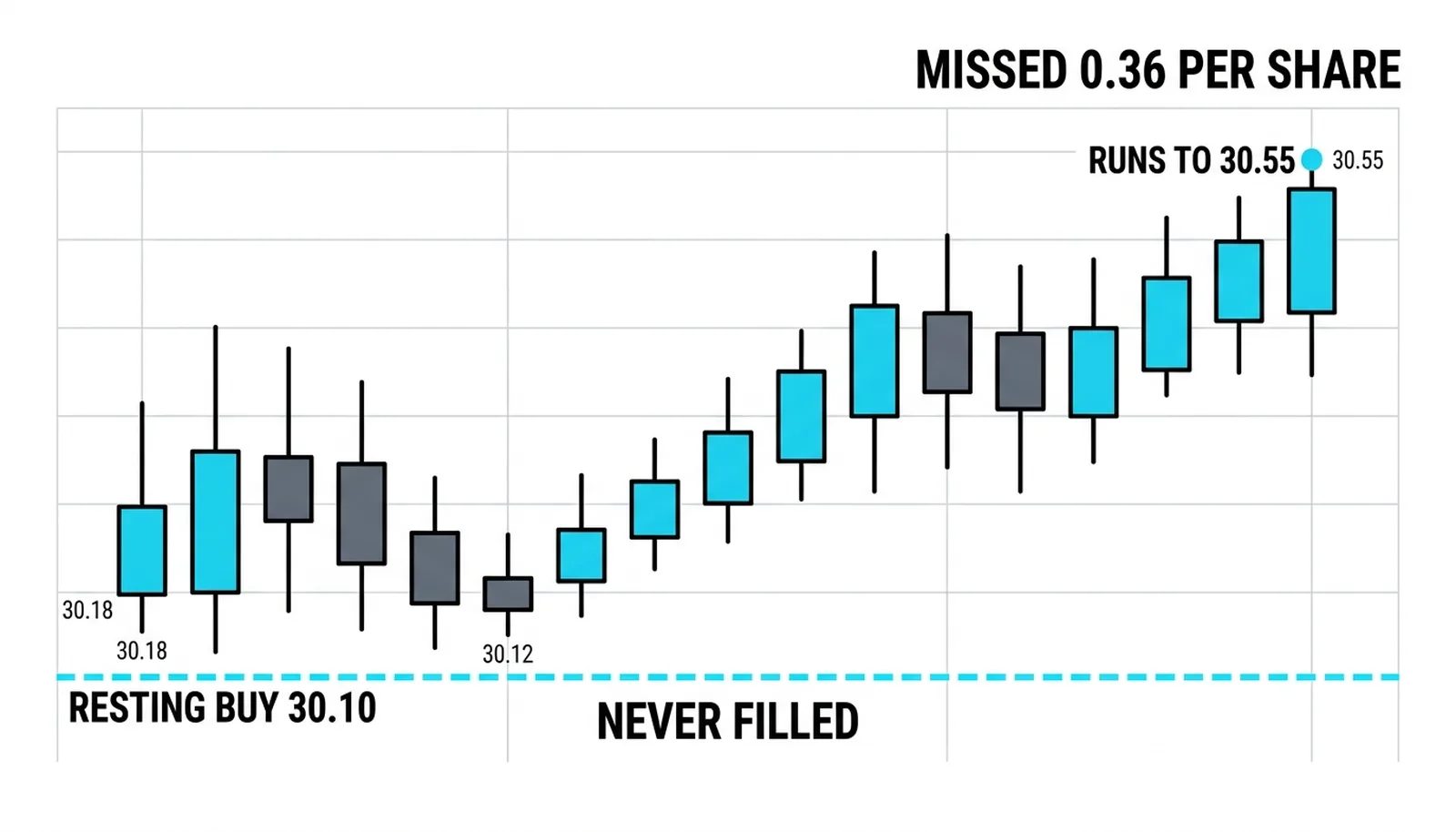
The catch is the fill that never comes. Price can approach your level, turn, and run, leaving your order untouched and the move gone. You kept your price and lost the trade. That is the limit order's version of slippage, paid in opportunity instead of ticks.
There is a quieter cost too, and it deserves its own honesty. When your resting buy does fill, it often fills because price is falling toward you and through you. Sellers needed your bid, and they needed it because the market was moving against the level. The queue pays for the privilege of being wrong efficiently. Traders call this adverse selection, and it is the limit order's hidden tax: your fills cluster on the trades you least wanted.
Choosing per Job
Neither order type is better. Each fits certain jobs and misfits others, and the choice should follow the job, not a habit.
Reach for the market order when being in or out matters more than a tick:
- Exits under threat. A stop has been hit, the thesis is broken, and the position needs to end. Certainty of exit beats a better price by a wide margin here.
- Entries into momentum. A breakout is moving and the setup only exists if you are in it. Waiting for a pullback fill often means watching the trade leave without you.
- Small sizes in liquid names. When the spread is a tick and your size sits comfortably inside the top queue, slippage is nearly free and speed is nearly guaranteed.
Reach for the limit order when price is the edge:
- Working an entry at a level. Your plan says the trade is only good at a specific price. A limit order enforces that discipline mechanically.
- Scaling out at targets. Resting sell orders at pre-planned levels let the market come to you, and they remove the temptation to renegotiate targets mid-trade.
- Patient accumulation. Building a position over time at prices you chose, with no urgency, is exactly what resting orders were built for.
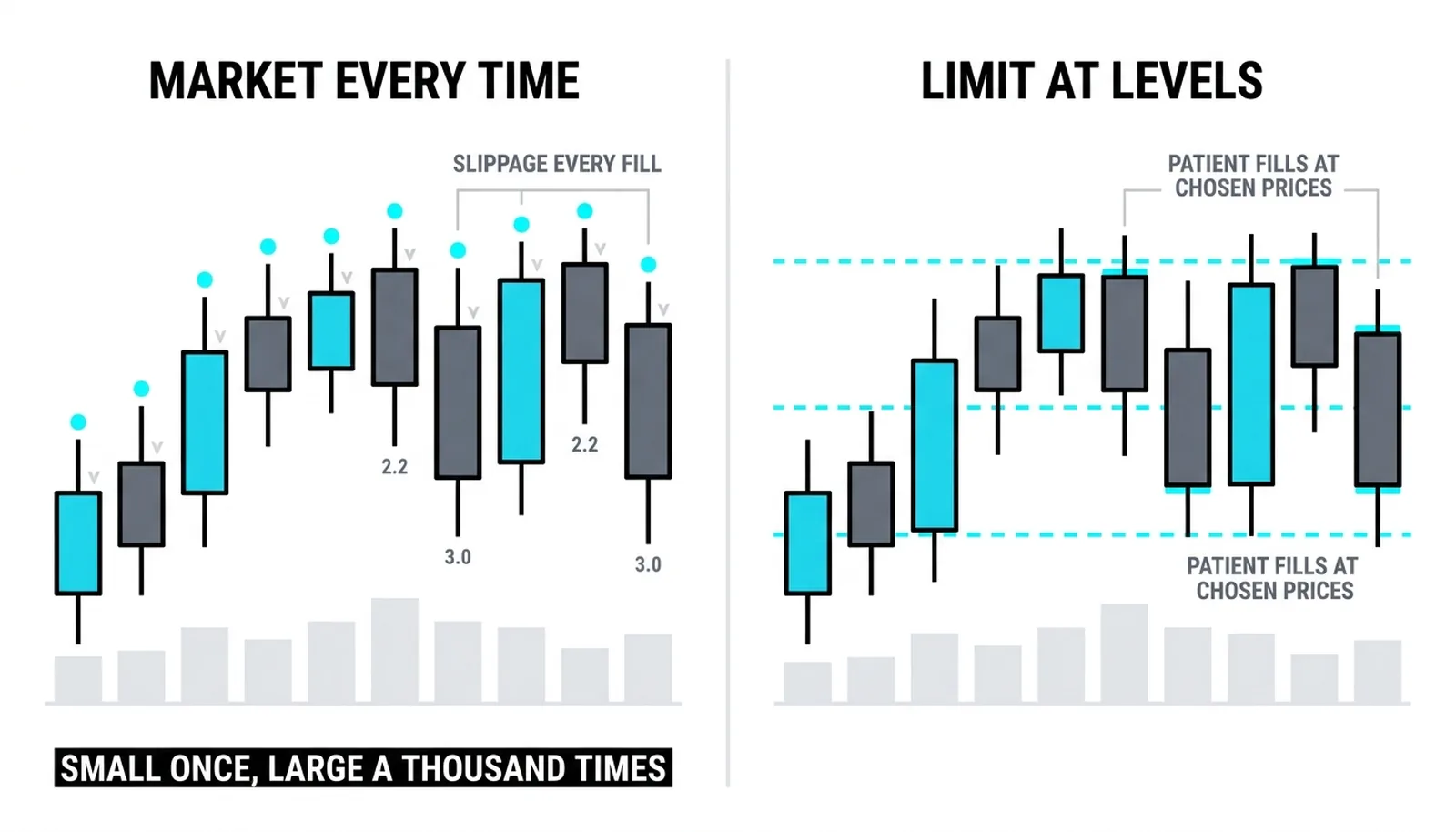
One more honesty beat, this time for the market order. Its hidden cost compounds. Slippage is small once and large a thousand times. A trader who market-orders every entry and exit in a fast, thin name can leak a meaningful fraction of a year's edge without a single dramatic fill to point at. The type you pick should match the size you trade and the speed you actually need, not the speed that feels decisive.
The Same Buy, Placed Two Ways
Everything below is hypothetical, with round numbers, to show both order types on the same trade.
A trader wants 500 shares of a stock quoted at 30.16 bid and 30.18 ask.
Path one: the market order. The order fires and fills instantly, but the size is bigger than the top queue. It takes 300 shares at 30.18 and walks the book for 200 more at 30.20. Average fill: 30.188. The trader is in, guaranteed, and paid about 0.008 over the screen ask for the privilege.
Path two: the limit order. The trader rests a buy at 30.10, below the market, hoping for a pullback. Price never comes back. The stock runs to 30.55 by the session's end, and the order fills nothing. The missed move costs 0.36 per share against where the market order would have entered.
Now a second day. Same stock, same 30.10 limit order resting. This time price pulls back, the order fills, and the trader buys 0.08 under the ask that a market order would have paid. Clean, patient, cheaper.
Read both days carefully. Day one shows the limit order's hidden cost: the fill that never came, and the move that left without the trader. Day two shows its payoff: a better price, earned by waiting. Neither day proves either order type wrong. The market order's slippage and the limit order's adverse selection and non-fills are not flaws to eliminate. They are prices, and the skill is knowing which price the current job should pay.
| Situation | Order type that fits | The reason | The cost you accept |
|---|---|---|---|
| Exiting a broken position | Market | Being out matters more than a tick | Slippage on the way out |
| Entering a live breakout | Market | The setup only exists if you are in it | Paying the spread, maybe walking the book |
| Buying at a planned level | Limit | Price is the edge of the trade | The fill may never come, or comes via adverse selection |
| Scaling out at targets | Limit | Resting orders enforce the pre-planned exits | Unfilled shares if price stalls below the target |
Market Orders vs Limit Orders, Answered
What is the difference between a market order and a limit order?
A market order fills immediately at whatever price the book offers, guaranteeing execution but not price. A limit order fills only at your price or better, guaranteeing price but not execution. You are always choosing between those two certainties.
When should you use a market order?
Use a market order when being in or out matters more than the exact price: exits under threat, momentum entries, and small orders in liquid names where slippage is minimal. The guarantee you are buying is the fill itself.
Why would a limit order not fill?
A limit order does not fill when price never trades at your level or better. The market can approach, turn, and run, leaving your order resting untouched. You kept your price and missed the trade, which is the limit order's built-in cost.
Can a limit order cost you money?
Yes, in two ways. A missed fill can cost you an entire move, and a fill through adverse selection often means price was falling toward your bid, so you bought just before it went lower. The limit order saves ticks and occasionally buys the wrong moment.
Order types are the vocabulary. The next lesson moves to the grammar: reading order flow imbalances, where clusters of these same market and limit orders start revealing what the crowd intends before price shows it.