Bid vs Ask: How Orders Are Filled
The bid and the ask are the two prices behind all orders: the bid is the highest price buyers are currently offering to pay, and the ask is the lowest price sellers are currently offering to accept. The gap between them, the spread, is where every trade begins. A buy fills at the ask, a sell fills at the bid, and which side got crossed tells you who was aggressive enough to pay for speed.

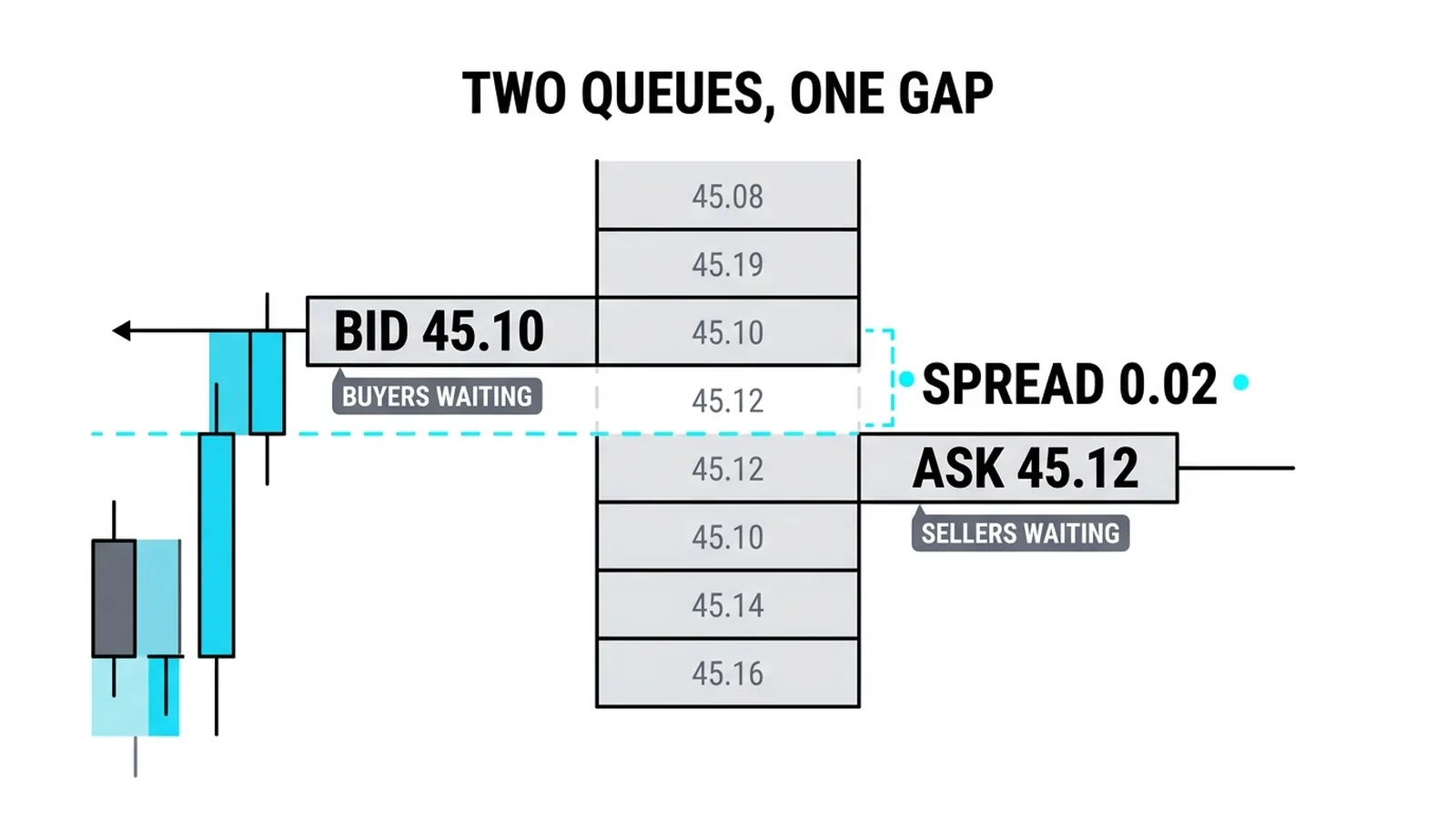
Picture two queues at a ticket window: sellers lined up on one side holding their price tags, buyers on the other, and a trade only happens when someone abandons their own queue, crosses the hall, and pays the other side's price. The previous lesson defined order flow and its three windows. This one owns the two prices the whole thing hangs on.
The Two Prices and the Space Between
Every liquid market carries two live quotes at all times. The best bid is the highest price any buyer has publicly committed to pay. The best ask, sometimes called the offer, is the lowest price any seller has publicly committed to accept.
Behind each quote sits a queue of size. A bid of 45.10 with 900 shares means buyers have committed to absorb 900 shares at that price. An ask of 45.12 with 600 shares means sellers have committed to supply 600 shares there. Size matters as much as price, because it tells you how much business each level can actually conduct.
The spread is the difference between the two. It exists because immediacy has a price and somebody has to be paid for standing ready. Market makers post both sides and earn the spread as their fee for that service, absorbing the risk that the market moves while they hold inventory.
Spread width is a liquidity signal. In heavily traded instruments the spread can be a single tick or less, because competition among liquidity providers squeezes it. In quiet or thin names the spread widens, sometimes dramatically, because fewer participants want the job of standing in the middle.
Order flow analysis states the governing rule plainly: limit orders provide the market's liquidity, but limit orders can never move it. Resting orders are the shelves. Only aggressive orders rearrange them.
How a Trade Actually Happens
A trade occurs when someone crosses the spread. A buyer who wants shares now sends a market order, which lifts the ask, taking shares from the sellers' queue. A seller who wants out now sends a market order, which hits the bid, dumping shares onto the buyers' queue.
Price only moves when a market order's size exceeds what the best queue holds. If the ask holds 600 shares and a market buy arrives for 400, the trade fills entirely at that one price and the quote survives. If the buy is 1,200 shares, it consumes the whole ask, then chews into the next level up. The quote advances because the aggressive side ran out of cheap supply.
The same logic runs downward. A market sell larger than the bid's queue clears the bid, then the level below it. Each exhausted level is one step of price movement, created by urgency, not opinion.
Whoever crosses pays for the privilege. The aggressive side absorbs the spread plus any slippage from walking through multiple levels. The passive side gets filled at their chosen price but accepts the risk of never being filled at all. That is the tradeoff at the core of every execution decision you will ever make.
Two styles, two costs. Limit orders buy price control and sell certainty of execution. Market orders buy certainty of execution and sell price control.
Reading the Tags Honestly
Every print on the tape carries a tag. A trade at the ask is buyer-initiated: someone was aggressive enough to pay the sellers' price. A trade at the bid is seller-initiated: someone was aggressive enough to accept the buyers' price. This tag is the foundation the entire order flow edifice stands on, because it converts raw transactions into a record of intent.
Now the first honesty check. The displayed book is not the whole book. Hidden and reserve orders sit behind the visible numbers, so the 600 shares you see at the ask may be the tip of a much larger supply. The reverse also happens: a large displayed order can be pulled the instant price approaches it, a manipulation tactic designed to fake support or resistance. A big resting order is a claim, not a promise.
The second honesty check is speed. The best bid and ask update constantly, sometimes many times per second. The book is live, not a photograph. Reading one snapshot as the market's settled position is how traders get fooled ten seconds later, when the queues they relied on have been replaced by entirely different ones.
The practical habit: treat the ladder as live evidence, not a fixed structure. Watch how size behaves when price reaches it. Size that holds and absorbs aggression is information. Size that vanishes on approach was decoration.
Twelve Hundred Shares Cross the Hall
All numbers here are hypothetical, round, and invented for illustration. A stock shows a best bid of 45.10 with 900 shares queued and a best ask of 45.12 with 600 shares queued. The spread is two cents.
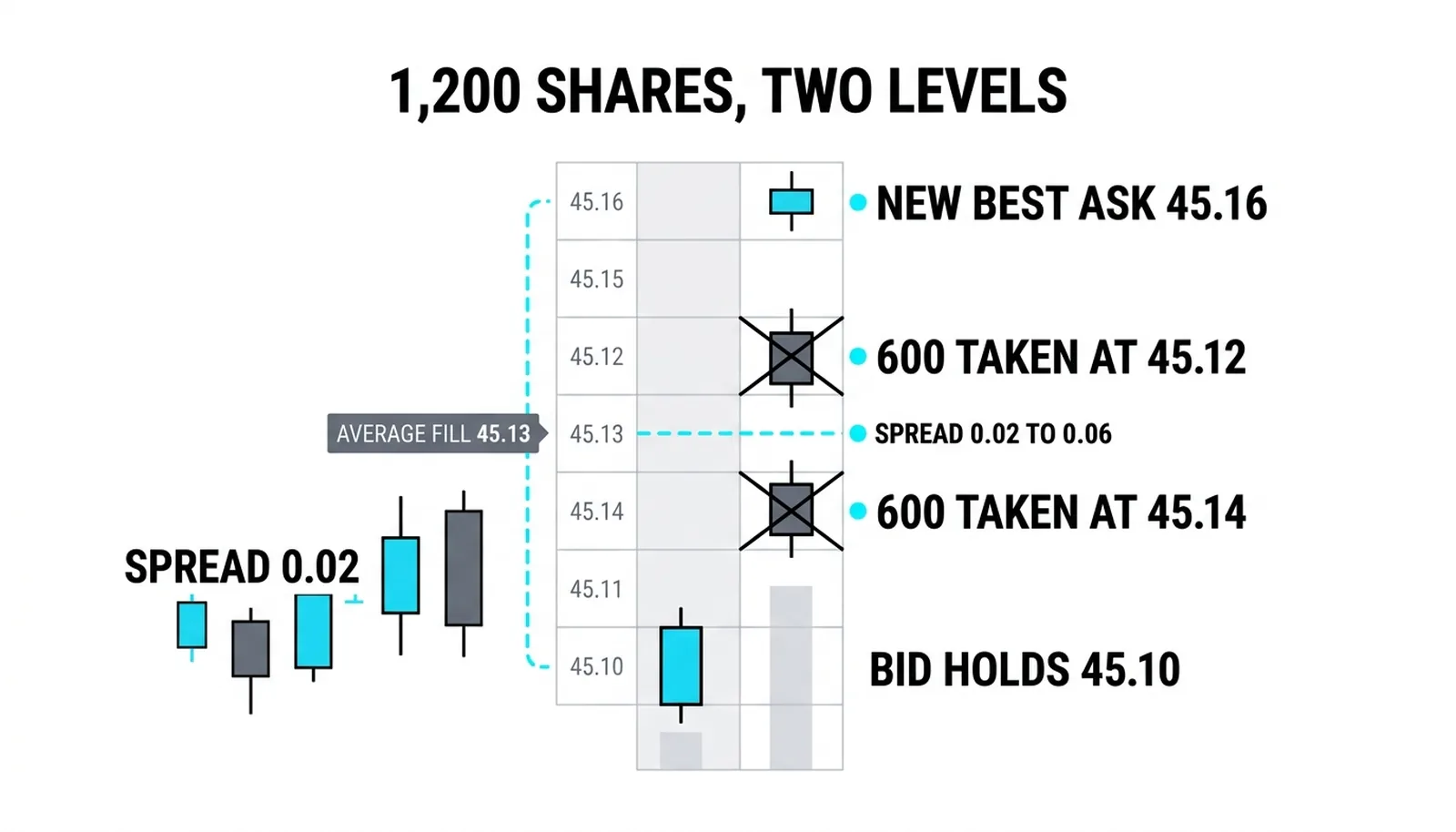
A market buy order for 1,200 shares arrives. Here is what happens, step by step:
- The first 600 shares fill at 45.12, consuming the entire best ask.
- The order still needs 600 shares, so it climbs to the next level, 45.14, and takes 600 shares there, emptying that queue too.
- The tape prints trades at 45.12 and 45.14, all tagged buyer-initiated.
- The best ask is now 45.16. The bid is still 45.10. The spread has widened from two cents to six.
The buyer's average fill is 45.13, not the 45.12 showing on the screen when the order was sent. That one-cent difference is slippage, the cost of urgency on a 1,200-share order in a book that only offered 600 at the front.
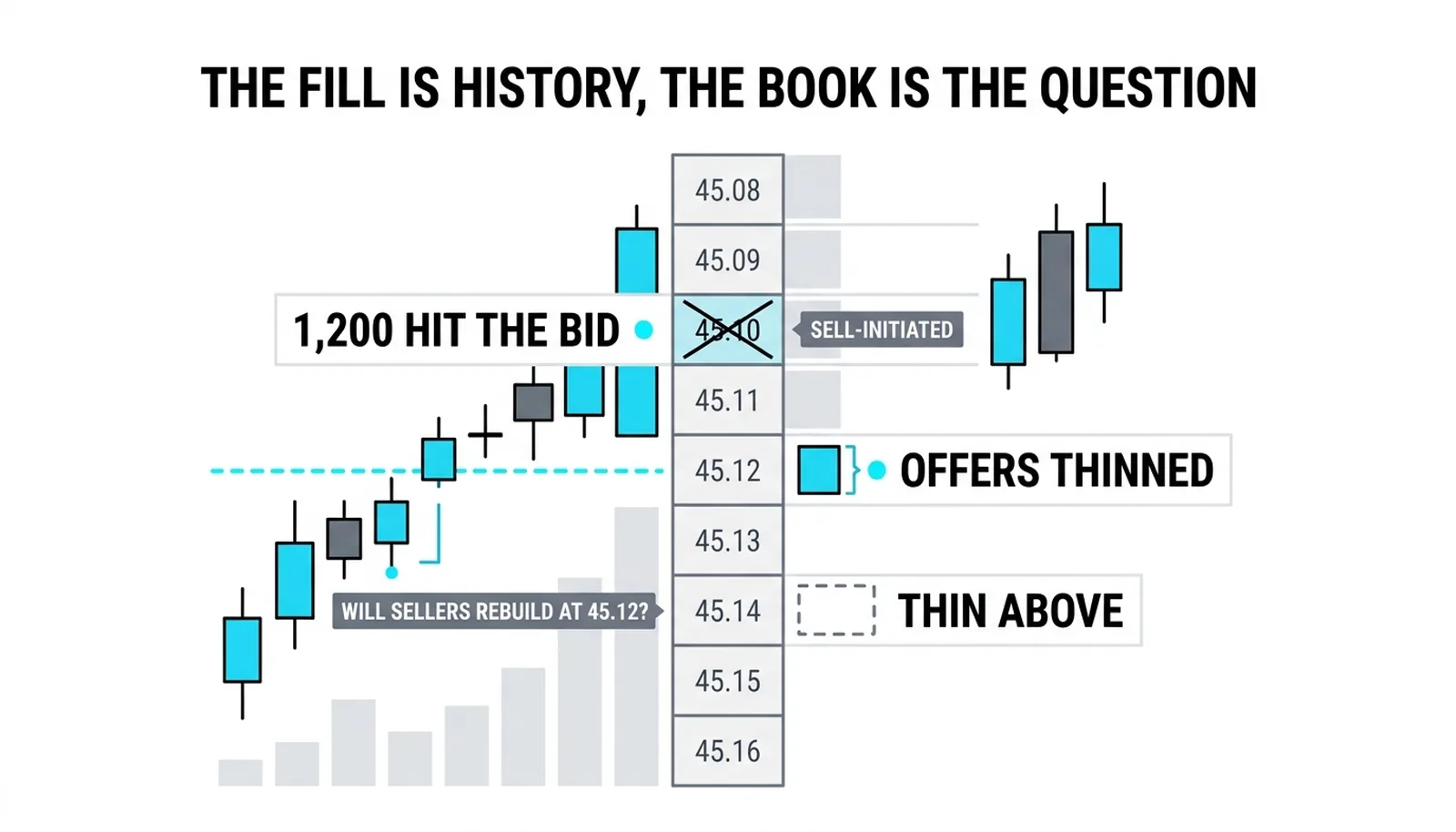
Read the aftermath like a detective. The buyer was aggressive and large relative to displayed supply. The ladder now shows thinned offers above and an untouched bid below. If new sellers step in at 45.16 and 45.18, the move may stall. If the offer side stays thin while buyers keep crossing, price has room to keep rising. The fill itself is history; the rebuilt book is the live question.
| Term | What it is | Who sets it | What it costs you |
|---|---|---|---|
| Bid | Highest price buyers will pay | Buyers posting limit orders | Selling here means accepting less than the ask |
| Ask | Lowest price sellers will accept | Sellers posting limit orders | Buying here means paying more than the bid |
| Spread | Gap between bid and ask | Competition among liquidity providers | The built-in fee for immediate execution |
| Slippage | Fill worse than the quoted price | Your order size versus queue size | Extra cost when your order walks multiple levels |
Bid vs Ask, Answered
What is the difference between bid and ask?
The bid is the highest price buyers currently offer; the ask is the lowest price sellers currently accept. Buyers want low, sellers want high, so the two never naturally meet until someone concedes and crosses.
Why is the ask higher than the bid?
Because the spread is the fee for immediacy, earned by whoever stands ready to trade with you on demand. If the ask ever sat below the bid, free money would exist and it would be arbitraged away instantly.
What does it mean to lift the offer?
It means a buyer used a market order to purchase shares directly at the ask price, removing shares from the sellers' queue. Enough lifting exhausts the level and pushes the quote higher.
Why did my buy order fill above the ask?
Your order was larger than the shares queued at the best ask, so the remainder filled at the next higher levels. The difference between the quoted price and your average fill is slippage, the standard cost of demanding size immediately.
Next in this block: the order types themselves, market versus limit, and how choosing between them is really choosing which cost you prefer to pay.